
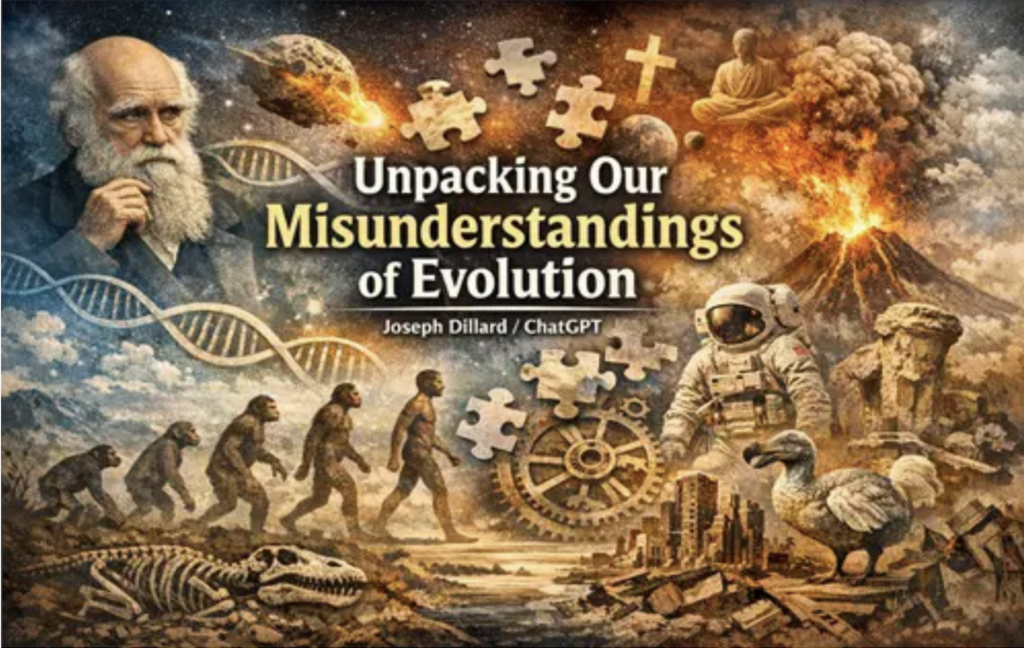
Our common misunderstandings matter, not simply for science and not simply for philosophy, religion, spirituality, and psychology, but for you and me and for how we perceive our place in the world and the meaning of our lives.
What IDL does is pragmatic evolutionary hygiene: it restores feedback where teleology, moralization, and certainty shut it down.
Evolution is Purposeful
In this misunderstanding, purpose is smuggled in where it doesn’t belong. Because you and I have goals and purpose is largely hard-wired into human cognition, we tend to assume evolution has goals. We have been raised in cultures that teach that evolution progresses, improves, becomes more intelligent, and increasingly moral over time, that evolution improves humanity, and it improves us. This is a major and fundamental misunderstanding of how evolution works, and that misunderstanding has major consequences.
Teleology, the assumption that evolution is purposeful, isn’t just wrong; it actively misleads. It leads us into fundamental misunderstandings about what evolution is and how it works, and those misunderstandings lead us into psychological and behavioral dead ends that translate as unnecessary collective and personal suffering and tragedy.
Evolution has no foresight, endpoint, or intention. It is mindless and is neither conscious nor unconscious. We know this because evolution selects outcomes and preserves only what works well enough, for now, in this context.
Why Evolution Is Not Purposeful
This concept feels heretical to those who have always assumed otherwise, because we humans are indeed purposeful. However, the evidence that evolution itself is not purposeful, in a planned sense, is overwhelming. For example, languages evolve without foresight, endpoint, or intention. No committee decided that “Awful” would once mean awe-inspiring and later mean terrible, or that “literally” would come to mean “figuratively,” or that “Google” would become a verb. These changes weren’t planned, voted on, or aiming at “better language.” They persisted only because they worked well enough in context. If a usage fails or confuses too many people, it disappears. If it works, it spreads; it survives. Language evolves by selection, not intention, which is exactly how evolution works.
However, evolution is purposeful in the sense that it is functional. Kitchen tools provide a practical, concrete example. No one sat down and said, “In a couple thousand years forks will have four tines.” Forks went through 2 tines, 3 tines, and many odd variants. Most failed because they were too fragile, awkward, or didn’t stab food reliably. What we use today isn’t ideal, just good enough. If a five-tined fork worked better in daily use, you’d own one. Similarly, evolutionary selection preserves what functions, not what is perfect, planned, or purposeful.
Old European cities weren’t designed top-down, which demonstrates how large-scale order emerges without a designer. Towns and cities grew by paths between wells, shortcuts to markets, and avoidance of mud or danger. Streets that were inconvenient were abandoned while those that were useful were developed. Towns and cities that sprang up naturally, organically, before city planners look intentional, but they weren’t. Cities like London and Rome look designed because what didn’t work disappeared. What remains is simply what survived long enough to feel inevitable. Now they look intentional. They weren’t. Order emerges retrospectively. Intention is projected backward.
Systems of all sorts improve without foresight. Programmers don’t know in advance which features users will love and which will break everything. So they release versions, observe what survives, and remove what causes crashes. Evolution works the same way, through random variation, ruthless filtering, and with no preview of outcomes. Selection happens after the fact. It isn’t purposeful.
Most of your habits formed because they reduced friction, they saved effort, or they avoided discomfort. You didn’t intend to form them. Nobody plans to be an alcoholic, spouse abuser, or supporter of genocide. People keeps what works or is rewarded. Our personal and collective habits evolve without conscious planning. The option is to claim that alcoholism, spouse abuse, or genocide are planned, purposeful choices. Bad habits persist not because they’re “good,” or “karma” based on past life choices, but because they work well enough under certain pressures. The persistence of our individual and collective behaviors is not destiny nor divine plan. Instead, they were once functional. Now we are stuck with them because they have planted themselves in our biology, emotions, thinking, or socio-cultural context in ways that makes them extremely difficult to extricate. They are in reality personal testimony to the purposelessness of natural selection.
Our resistance to antibiotics provides another concrete example of how evolution is blind. Bacteria don’t “decide” to become resistant. We don’t develop a resistance to antibiotics because of “karma.” What happens is that random mutations occur. Antibiotics kill most bacteria but a few happen to survive and those survivors reproduce. Resistance to antibiotics spreads without knowing antibiotics exist, without foresight or intention. If evolution had foresight, resistance wouldn’t surprise us.
My wife Claudia was a talented and skilled naturopath, yet she was killed by an immune system over-reaction to an antibiotic she had taken several times before. Her death was not purposeful, planned, predestined, karmic, or “providential.” It had no meaning beyond the reality that, unknown to her or her doctors, her body had built up a defense against that antibiotic over time. This was evolution at work, ruthlessly selecting for extinction that which is not functional. We can hate it and view it as unjust or meaningless. But evolution cannot and will not occur without the ability to test limits and make selections.
If evolution had an upward arc, why do 99% of species go extinct? If evolution knew where it was going, why is there so much waste, redundancy, and dead ends? Why do intelligent, caring people still support mass killing? A process with foresight wouldn’t look this messy, cruel, or self-destructive.
How IDL compensates
IDL decouples meaning from cosmic purpose and relocates it inside local, provisional function. IDL interviewing does not ask what this dream means or what it’s for. It does not ask why we are experiencing this life drama or why we had this synchronicity or psychic experience. It asks: What does this perspective experience? What does it want? What does it fear?
This mirrors evolution exactly because IDL interviewing does not assume a goal, endpoint, or guarantee. In is only interested in what functions now in this context. IDL trains us to generate situational purpose without projecting destiny.Purpose becomes adaptive, revisable, and grounded in lived feedback rather than metaphysical expectation. IDL restores purpose as an emergent response, not a pre-written script.
Why People Feel This Is Heresy
We have been scripted to silently smuggle in progress, direction, and meaning, because we confuse utility with purpose and because we fear that an absence of purpose behind evolution means nihilism – a lack of meaning or purpose for living. However, that conclusion does not follow rationally, although it does follow emotionally for many people. Evolution says only “This works here, now,” not “This is better,” “This is leading somewhere,” or “This was meant to happen.” As with my wife Claudia, what survives today can fail tomorrow when conditions change. We don’t like that conclusion; we fight the inevitability of death, not understanding that it is both meaningful and necessary, even while tragic and extremely painful. We assume that evolutionary collapse and death are somehow abnormal and a glitch or regression in the inevitability of advancement. The reality is that collapse is not only a normal but a necessary characteristic of evolution.
When we assume evolution has a purpose, we expect history to “bend toward” some positive destination, like a grand Hegelian synthesis, a de Chardin Omega Point, or a Wilberian enlightenment. We tend to hear evolution as occurring without purpose as a statement that life is therefore meaningless. This is not at all the correct conclusion. Evolution is indeed meaningful, just not in the ways that we assume. We tend to assume that something that doesn’t have purpose is therefore meaningless when that is often untrue. Rain falling is highly meaningful but it does not fall because of some interior purpose. We also tend to assume that causation implies purpose. Many things cause rain to fall, but are any of those things purposeful? The tragedies of life are highly meaningful, and we can always point to causative factors, but does that mean the tragedy had some purpose behind it? Certainly we can always project purpose upon tragedy or anything else, and sometimes, particularly regarding human events, there was indeed purpose involved. But we ascribe purpose backwards to events to give them meaning beyond causation. The problem is that this can cover up a deeper sense of meaning that we thereby miss, a depth of meaning that does not rely on purpose.
Reframing the Meaning of Evolution
Mindless does not mean meaningless. It means meaning is generated locally, not guaranteed globally. Evolution doesn’t give purpose. Purpose arises within evolved beings. Purpose is an emergent evolutionary development. It exists because humans select for purpose, not because selection is planned. That meaning is generated locally rather than hard-wired into nature does not make nature or life or death less meaningful. However, that understanding does make life both more honest and more intimate. Because we seek both honesty and intimacy, humanity will eventually outgrow its dependency on a projection of purpose onto nature. Instead, future generations will experience life in a deeply intimate way because they have moved beyond denial and into an acceptance of life as meaningful in and of itself, apart from our feelings, preferences, and thoughts.
Morality Drives Evolution
A further common mistaken confusion arising from the belief that evolution is purposeful is the equation of success with moral worth. Those things that are most advanced in an evolutionary sense are most moral. But evolution is not moral, immoral, or amoral. It functions outside the domain of values. From an evolutionary perspective, theodicy, contemplating why there is evil in the world makes no sense, because evolution does not function in terms of good or evil.
How IDL compensates:
IDL suspends moral interpretation and replaces it with phenomenological inquiry. Interviewed dream figures are not judged as good/bad, higher/lower, enlightened/pathological. A tyrant, a murderer, a demon, a child—all get equal airtime. This mirrors evolutionary selection. Evolution does not reward virtue. It rewards fit within systems. IDL trains practitioners to see adaptive function without moral overlay, which reduces ideological rigidity, increases systemic understanding, and prevents projection of goodness or evil onto forces that are simply adaptive under constraint.
We Have a Destiny
A further common misunderstanding is that we assume we have a destiny to be fulfilled. This produces entitlement, rigidity, and despair when reality doesn’t comply. We treat ourselves as meant to be something rather than what is actually true from an evolutionary perspective: we are provisionally adapted to our circumstances. That does not mean we should not set meaningful purposeful goals and strive to fulfill them. It means that we set personal goals knowing that evolution itself doesn’t care about our goals, and when we understand that and align ourselves within that naturalistic structure, we are more likely to achieve our goals.
How IDL compensates:
IDL replaces destiny with provisional identity. Every interviewed perspective is temporary. No self is “who you really are.” Identification is fluid and contextual.
Dream Yoga reveals that selves arise because they worked. They persist because feedback hasn’t yet forced revision. IDL therefore trains identity flexibility, which is the only psychological equivalent of evolutionary survivability. You don’t “become” something in IDL. You learn when to let go of what no longer works.
Purpose Generates Possibility
The most fundamental misunderstanding of the relationship between purpose and evolution is that teleology generates possibility when it actually limits it. Once you think there’s a “right direction,” you stop noticing the adjacent possibles that actually drive emergence. Purpose puts a finger on the scale of random selection, thereby limiting selection possibilities, what we call “creativity.” The sun provides an example. If it were purposeful and strived for some end, then the sun would limit its behavior. It wouldn’t send out dangerous solar flares. It would know when we are experiencing drought and reduce its intensity. In other words, it would become mercurial, erratic, and subject to the preferences of humans. But the sun is constant and dependable because it is not compassionate or caring. If it were, it would not produce the constraints necessary to drive evolution.
How IDL compensates:
IDL systematically expands variation before selection. Dreams are inherently non-teleological. It interviews multiplies perspectives rather than converging on a conclusion. No interpretation is privileged in advance. This restores random variation, as dream imagery and many transpersonal experiences are random. It also restores election through the lived integration of what actually helps. IDL therefore reopens evolutionary creativity that goal-fixation shuts down.
Randomness Is Accidental
We hear “random mutation” and think evolution is chaotic, accidental, or implausible. While variation may indeed be random, selection is not, and neither is context. Randomness only operates inside massively constrained systems.
For example, the ultimate randomness of quantum indeterminacy cannot and will not generate a duck. You don’t get a duck by maximizing randomness. Instead, to arrive at a duck via evolution, you have to reduce, limit, and constrain randomness in millions of ways that include physical laws, chemical affinities, developmental pathways, environmental pressures, and historical consequences. While randomness maximizes evolutionary options, it only does so within the limits of iron constraints. Those constraints have to be real to generate the necessary structures that will eventually produce a duck.
Why this understanding of the constraints under which the randomness of evolution operates matters for you and me is that it protects us from common bipolar conclusions. Typically, people conclude from evolutionary randomness either that “Anything could happen” and thereby become nihilistic, believing neither life nor their own existence has meaning, or that “Nothing meaningful can emerge,” which is cynicism, also an incorrect and untrue conclusion.
In reality, creativity arises naturally and inherently within evolution because of constraint. Without those constraints there would be no ducks or you or me. Freedom is not a precondition for the evolution of ducks but a consequence of the constraining structures that produced them.
We can see that same principle child development. The freedom to ride a bike and explore the neighborhood is a consequence of having access to a bike and learning to ride it. Those constraining preconditions make possible the freedoms bike riding provide. Freedom increases after structure, not before. This is why the common assumption that maximizing freedom in child rearing is a mistake. Evolution requires the constraints of structure for freedom to emerge in more complex forms.
Similarly, meaning itself, whether personal or regarding life itself, is emergent, not preordained or “programming” evolution or development. Meaning emerges out of the constraints of our particular life context. This fundamental misunderstanding of randomness is the same mistake people make psychologically when they seek “freedom” by dissolving all structure. They produce collapse, not creativity.
A very instructive example is provided by the CIA funded experiments of psychiatrist Dr. Ewen Cameron, President of the American and International Psychiatric Associations. From 1957 to 1964 Cameron used massive electroconvulsive therapy, drug-induced sleep, sensory deprivation and sensory overload to “deconstruct” the personalities of patients in order to “rebuild” healthy personality structures. Many patients suffered permanent damage, including amnesia, incontinence, and loss of basic motor skills and memories. Some could no longer recognize family members. The extreme trauma often destroyed personalities rather than creating compliant subjects. However, Dr. Cameron’s research did provide the CIA with a variety of extremely effective torture techniques.
The removal of contextual constraints does not produce freedom but evolutionary collapse, regression, and chaos. This is why Elon Musk’s Mars colony project is destined to fail: both space itself and Mars lack the fundamental structural constraints necessary to maintain life. While the consequences of the absence of these constraints can be defied temporarily, like a plane defying gravity, underlying limiting evolutionary pre-existing structures eventually require compliance as a pre-requisite to freedom. People can defy those constraints for months in space but not for years. Ignoring them eventually leads to inevitable systemic collapse.
Meditation, mysticism, and the pursuit of enlightenment can provide similar temporary freedom from pre-existing constraints, like a fear of meaninglessness or an avoidance of personal and collective suffering. In fact, avoidance of the constraints of waking experience is a major function of the dreaming that we do for over two hours every night, some five years of our life. These excursions to the edge of chaos are both necessary and temporary. However, attempts to extend them as majority life and evolutionary experiences generates systemic collapse. This is a basic principle of evolution, and to misunderstand it or to believe that you are an exception is to invite Cameron’s consequences for his experimental subjects.
How IDL compensates:
IDL shows randomness operating inside constraint. Dreams generate wild variation. The interview process constrains that variation through structured questions. Waking integration selects what actually improves balance. IDL embodies the evolutionary truth that freedom emerges after structure, not before. Dream Yoga is not free association; it is disciplined randomness.
Evolution Is About Optimization
It is commonly assumed that evolution makes things better. Evolution only makes things good enough to survive reproduction, often at enormous cost. Just like DNA, molecular and cellular structures, many inherited traits are fragile, wasteful, cruel, only temporarily advantageous, or are in reality long-term liabilities.
To take a fundamental and well-known geopolitical example, “might makes right” is a well-proven successful strategy to generate personal and collective benefits. Colonialist nations have long employed “might makes right.” We can draw a direct line from ancient Greek colonization through Roman, Christian, European and U.S. colonialism. We now currently have the spectacle of representatives in the British Parliament decrying the U.S. as a “bully” for employing on Europe (in regard to Denmark and Greenland) the same tactics Europe has long employed on others. “Might makes right” is not a “bug” in human software. It is not evil or immoral. From an evolutionary perspective, it is an adaptive feature, a context-bound adaptation.
Might makes right persists because it “works” in the short run. Evolution selects for “might makes right” because it supports survival. However, “might makes right” has only limited evolutionary functionality because evolutionary emergence selects for both survivability and cooperation. All entities exist in systems with interdependent relationships. Optimizing power ignores a fundamental the evolutionary components of reciprocity and interdependence. Interdependence on an evolutionary level means that molecular, cellular, and species actions have consequences for those bodies that generate those actions. Reciprocity means that the sort of power that is projected becomes activated upon the agents that employ it. Without cooperation survivability becomes maladaptive at some point. Power alone outlives its usefulness.
While we are wired to expect psychological coherence, moral improvement, and rational societies, evolution produces patchwork minds, conflicting drives, and institutions optimized for yesterday’s problems. This misunderstanding fuels moral outrage instead of systemic understanding. For example, it is currently in fashion to be morally outraged at the behavior of Donald Trump. From an evolutionary perspective Trump is an experiment that randomly tests the limitations of structures assumed to be constraining. Are they? Are they still real constraints or have contexts changed in such a way that they are no longer genuine evolutionary constraints?
Evolution is not about optimization. It is about random variation, which is always important to maintain and practice, as circumstances change and different constraints provide avenues for evolutionary emergence. Dreams are primary, always available sources of random variation, and therefore vehicles for evolutionary optimization.
How IDL compensates:
IDL exposes the mind as an adaptive collage, not a unified system. Conflicting dream selves coexist. None are optimized. Many are maladaptive but persistent. IDL does not aim to “fix” the psyche. It aims to restore feedback among parts so maladaptation can be detected before collapse. This mirrors evolution’s actual priority, not improvement but continued learning capacity.
Selection Rewards Individuals
We tend to assume that evolution rewards effort, intelligence, virtue, or insight, and that therefore, if we are the smartest monkey in the tree, evolution will reward us. The reality is that selection rewards systemic fit, not merit. Very smart sociopaths can and do fulfill systemic fit within evolutionary subsystems. Maladaptive individuals can succeed and even rise to the top of systems that reward dysfunctional behavior. However, because such a system is itself, by definition maladaptive, it will eventually collapse, bringing down its constituent well-adapted members with it.
However, the most ethical societies can collapse. The Chinese government, which has an impressive record of prosecuting corrupt bureaucrats, leaders, and corporate heads, largely runs on Confucian meritocracy. Still, if the Chinese government does not continuously adapt to changing circumstances to maintain systemic fit, it can and will collapse. The most adaptive individual can fail if embedded in a failing system. This reality regarding the actual functioning of evolution is devastating to modern identity structures. It challenges and negates common belief systems, including, “If I do the right thing, I’ll be okay.” “If society is rational, it will self-correct.” “Truth eventually wins.” None of these are guaranteed. Evolution selects patterns, not intentions. A great deal of contemporary thought ignores this reality. The smartest species can and do go extinct.
How IDL compensates
IDL shifts focus from individual virtue to systemic balance. Dream figures represent relational dynamics, not personal traits. Pathology often turns out to be systemically functional. Health is relational, not individual. IDL therefore trains people to ask, “What system is this behavior adaptive within?” Which is the only question evolution ever answers.
Learning Prevents Collapse
We assume evolution equals cumulative improvement. However, the reality is that life only improves when feedback loops remain intact. When feedback, what can also be understood as interdependence and reciprocity, is disrupted, maladaptive traits, such as institutionalized and rewarded sociopathy, persist. Systems double down on failure. For example, sanctions on Russia continue to be imposed despite ample evidence they strengthen the autonomy of the Russian economy while hastening the de-industrialization of Europe. Collapse accelerates. In such circumstances, learning does not happen because denial prevents it.
For biological extinction, civilizational collapse, and psychological breakdown, learning stops before collapse becomes visible. We wait for evidence, consensus, and authority, but evolution doesn’t wait. We turn adaptive stability into rigidity and resistance to change. By the time consequences are undeniable, selection is already underway.
This is why micro-learning matters more than ideology. Dreaming is a form of micro-learning, functioning as an early warning system of a shut-down to learning and adaptive flexibility. The consequence of ignoring such early warning micro-learning is the breaking down of cumulative improvement, presaging systemic collapse.
How IDL compensates
IDL restores micro-feedback loops through dreaming. Dreams function as early warning systems. Ignored dreams signal learning shutdown. Interviewing reopens blocked feedback before crisis hits waking life. IDL is therefore preventive evolutionary maintenance, not enlightenment.
We Are Outside Evolution
We like to think evolution happened to us, not through us and not as us. The reality is that our beliefs, fears, institutions, bureaucracies, and moral narratives are all evolutionary artifacts, not transcendences of evolution. This illusion creates moral absolutisms, such as, “We stand for truth, goodness, and justice; our opponents do not.” It generates ideological rigidity, such as the assumption that there is only one “right” understanding of democracy – our version. It also creates an inability to revise identity. Even if we no longer like who we are, our comfort and addictions lock us into an increasingly fragile and vulnerable sense of self. Believing we exist outside evolution allows us to weaponize certainty, which in turn allows us to ignore our involvement in factors leading to our own collapse, such as crimes against humanity. When we fail to recognize our own views as provisional adaptations, we defend them as eternal truths. We see that in ideological allegiances of all kinds, for instance in Wilber’s commitment to his AQAL model despite shifting contexts and constantly emerging relevant new data. That’s not wisdom—it’s maladaptation. We do not exist outside evolution; we are and forever will be a product of it.
How IDL compensates:
IDL makes identity explicitly evolutionary. Every belief is an adaptation. Every worldview is provisional. Even IDL itself is revisable. This produces humility not as virtue, but as adaptive necessity.
Evolution Favors Stability
We equate success with preservation. However, evolution routinely destroys what is stable when it becomes inflexible. Death is evolution adapting to changes in contextual constraints. While stability without learning generates brittleness, brittleness and change together generate collapse. This explains why civilizations fall, institutions rot, identities shatter under stress, and why denial accelerates breakdown. The adaptive move is not control or certainty. It is maintaining access to feedback. Evolution favors a balance between stability and chaos, between adaptation and selfless reorganization, between precipitation and sublimation, survival and cooperation. When we ignore, forget, or lose that balance, usually by favoring stability, earthquakes shatter foundations assumed to be secure.
How IDL compensates:
IDL trains oscillation, not stasis. Waking adaptation oscillates with dreaming reorganization. Precipitation oscillates with sublimation. Stability oscillates with chaos. Dream Yoga operationalizes the evolutionary sweet spot. Enough stability to survive and enough disruption to learn.
Evolution is about outcomes
It’s not. Evolution is about keeping the conditions for learning open. That is why teleology fails, absolute meaning collapses, and certainty becomes dangerous. It is why practices that restore feedback matter more than beliefs. It is why approaches like Integral Deep Listening make evolutionary sense without making metaphysical claims.
Evolution doesn’t care if we survive. However, we can care about remaining capable of learning. That is the narrow, fragile, and precious opening where human responsibility actually lives.
How IDL compensates
IDL is process-first. There is no promised transformation, no guaranteed insight, and no teleological arc. Success is defined narrowly and realistically: “Is feedback still accessible?” That is the only condition evolution actually preserves.
Implications
In light of this understanding of how evolution actually works we can draw certain conclusions.
First, while suffering and tragedy are built into evolution, it makes sense to minimize it rather than compound it by holding on to misunderstandings that generate more. This implies cultivating access to the edge of chaos instead of ignoring or fearing it.
Second, we can become aware of the seductiveness of comfort, security and our tendency to weave ourselves into tailor-made death shrouds long before we grow cold.
Third, we need to cultivate self-doubt and humility, recognizing we are not in charge, that evolution is.
Fourth, we need to find and practice descent into chaos. There are multiple different practices, including meditation, psychedelics, the employment of severe physiological stress, certain varieties of dreamwork, and taking a deep personal dive into a foreign culture with a divergent worldview, that test current adaptive constraints while providing openings to evolutionary emergence. Dreamwork is low-hanging fruit in terms of easy, always available feedback regarding early warnings of systemic imbalances.
We have available to us both the knowledge of our misunderstandings regarding evolution and the tools to self-correct. What is in question is our willingness to harness both in our own self-interest.
IDL Dream Yoga does not claim to guide evolution. It restores the conditions under which evolution can still operate through us. Those conditions include feedback over belief, function over meaning, balance over optimization, and learning over certainty. That is why IDL both makes evolutionary sense and supports healing, balancing, and transformation without metaphysics, without progress myths, and without consolation narratives.
Questions for Integration
1.Where do you most strongly notice yourself projecting purpose, destiny, or moral direction onto events in your own life?
How might that projection reduce your capacity to notice alternative adaptive responses?
2.Which personal habits, identities, or beliefs persist in your life primarily because they once “worked,” rather than because they are still functional now?
What feedback have you been ignoring?
3.How do you personally respond—emotionally, not intellectually—to the idea that evolution is mindless but meaningful?
What fears or resistances arise, if any?
4.Where in your professional role (coach, clinician, teacher, caregiver) do you feel pressure to provide certainty, meaning, or moral clarity—even when the system itself may be maladaptive?
5.How might restoring feedback (rather than seeking improvement or optimization) change how you work with dreams, clients, students, or yourself?
⸻
Test Yourself On What You Have Learned
Multiple-Choice Quiz: Evolution, Meaning, and IDL Dream Yoga
Instructions:
Select the best answer for each question. Each question assesses conceptual comprehension rather than agreement.
⸻
1. According to the essay, the primary misunderstanding about evolution is that it is:
A. Too slow to respond to modern conditions
B. Morally neutral and therefore dangerous
C. Purposeful, progressive, or goal-directed
D. Dependent on randomness alone
⸻
2. Why does the author argue that teleology causes unnecessary suffering?
A. It denies spiritual meaning
B. It encourages passivity
C. It shuts down feedback and adaptive learning
D. It promotes nihilism
⸻
3. Language evolution is used as an example because it demonstrates that:
A. Human intelligence drives evolutionary progress
B. Evolution requires conscious intention
C. Meaning stabilizes systems
D. Functional selection occurs without foresight
⸻
4. In the essay, morality is described as:
A. The endpoint of evolution
B. An emergent human adaptation
C. A necessary selection pressure
D. Evidence of evolutionary progress
⸻
5. What does IDL Dream Yoga intentionally avoid asking in dreamwork?
A. What emotions are present
B. What the perspective experiences
C. What functions now in context
D. What the dream means or is for
⸻
6. According to the text, randomness in evolution is best understood as:
A. Evidence that life is accidental
B. Unlimited chaos
C. Operating within strict constraints
D. A flaw in evolutionary theory
⸻
7. Why does the author argue that removing constraints does not produce freedom?
A. Constraints are morally necessary
B. Freedom precedes structure
C. Collapse occurs without organizing limits
D. Evolution favors control
⸻
8. From an evolutionary perspective, why do maladaptive behaviors and systems persist?
A. Because they are morally justified
B. Because they are consciously chosen
C. Because they once functioned within specific contexts
D. Because evolution favors intelligence
⸻
9. What does IDL mean by “provisional identity”?
A. Identity is false
B. Identity is socially imposed
C. Identity is fluid and context-dependent
D. Identity should be dissolved
⸻
10. According to the essay, the most accurate description of evolution’s priority is that it:
A. Rewards virtue
B. Optimizes outcomes
C. Guarantees survival
D. Preserves access to learning and feedback
⸻
Answer Key
1.C
2.C
3.D
4.B
5.D
6.C
7.C
8.C
9.C
10.D