
Integral Deep Listening focuses on evolutionary emergence rather than therapy, while still including therapy. To understand this distinction we first need to look at different approaches to therapy. Then we can compare/contrast those with evolutionary emergence.
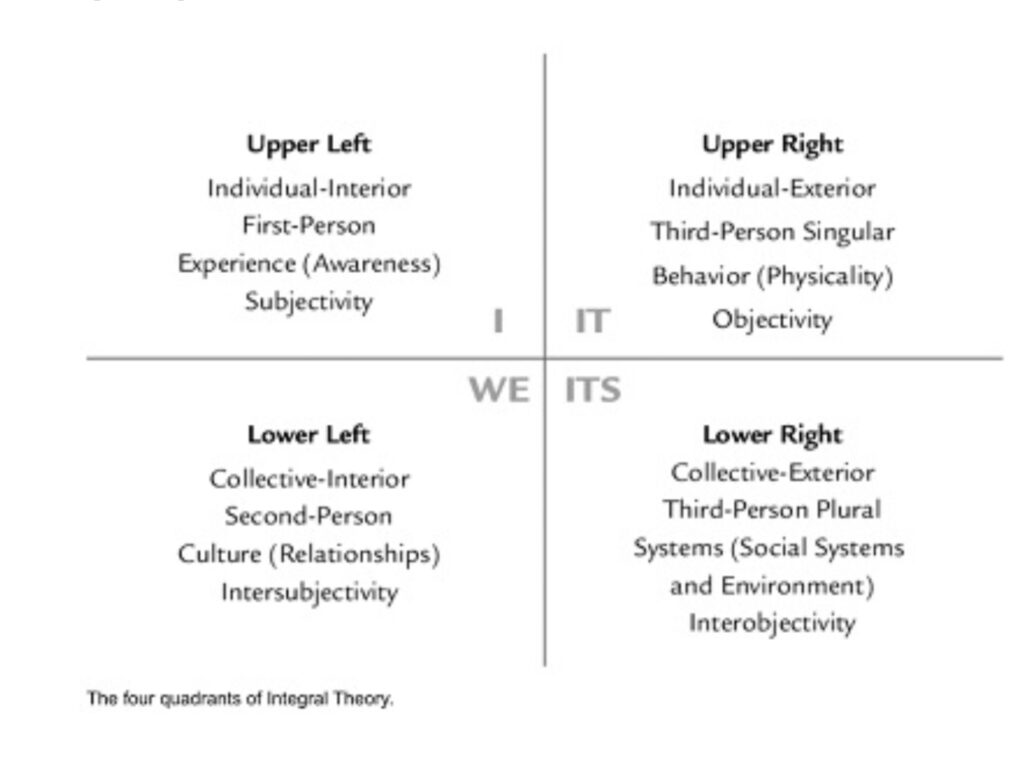
Above is a diagram of Ken Wilber’s four quadrants of his Integral AQAL (All quadrants, levels, lines, states, types). All domains of human experience focus in one or another of these four quadrants, and each has applications in all four quadrants. In this essay, we focus on the relationship between therapy and evolutionary emergence, and each of these four domains provide good examples of that concept. Psychological therapies are primarily interior and individual, in that they focus on the interior mental states of individuals, yet, as we shall see, they involve all three of the other quadrants. This is because everyone and everything is a part and a whole, called a “holon,” and all holons possess these four quadrants. Can you think of a part that is not part of a whole? Can you think of a whole that doesn’t contain parts? Can you think of a part/whole that doesn’t contain all four of these quadrants? For example, evolutionary emergence is primarily exterior and collective, in that it focuses on systems, yet is both collective and individual, interior and exterior.
We might ask, “Why four quadrants?” “Why interior/exterior and individual/collective?” While one can think of other fundamental characteristics besides those four basic characteristics, like time and space, these four are fundamental, and it is not difficult to understand why. We can ask ourselves, “Have I ever seen an interior that didn’t have an exterior?” “Is there such a thing as an exterior that doesn’t have an interior?” “Are there individuals that are not members of collectives?” “Are there collectives that do not have individual members?”
These questions demonstrate the fundamental nature of these four quadrants and why they differentiate experience in ways that are also meaningful and helpful. Let us look at some of the ways that is the case for psychology, because most of us are interested in understanding ourselves and reducing ways our feelings and thoughts can sabotage our happiness and development.
Psychotherapeutic Approaches in Each AQAL Quadrant
Upper-Left (UL): Interior–Individual
The Interior-Individual quadrant is also called the “Upper-Left” or UL quadrant in Wilber’s model. It involves our subjective experience, meaning, affect, thinking, intention, and states, like waking, deep sleep, dreaming, and the transpersonal. Here are well known examples of therapies that focus on the interior-individual quadrant.
Psychodynamic / Psychoanalytic Therapies
These work with unconscious conflict, internalized relationships, and intrapsychic meaning. Famous proponents are Freud, Jung, and Adler.
Humanistic–Existential Therapy
These focus on lived experience, authenticity, meaning-making, and emotional presence. Major proponents are Rogers and Yalom.
Mindfulness-Based Therapies
These cultivate awareness of thoughts, emotions, and sensations without identification. Their primary aim is insight, emotional integration, and subjective well-being. Examples include MBCT (the Mindfulness-Based Cognitive Therapy of Jon Kabbat-Zinn) and ACT (the Acceptance and Commitment therapy of Steven Hayes).
Upper-Right (UR): Exterior–Individual
The exterior-individual quadrant involves behavior, neurobiology, and measurable function. Their natural home is this quadrant because they are observable and focus on measuring individual elements, such as synapses, cells, organs, and individuals. These objective entities are measurable and subject to collective confirmation in ways that the interior quadrants are not.
Cognitive-Behavioral Therapy
CBT modifies observable behaviors and measurable cognitive patterns like emotional cognitive distortions and cognitive biases. It is associated with Aaron Beck and David Burns.
Behavioral Therapy
These are exposure and conditioning-based approaches that target stimulus-response patterns and habit loops. Examples include the classical conditioning demonstrated by Pavlov and the operant conditioning of BF Skinner.
Psychopharmacology / Neurobiological Interventions
These approaches alter brain chemistry and physiological functioning. Their primary aim is symptom reduction and functional improvement. This is the domain of mainstream contemporary psychiatry.
Lower-Left (LL): Interior–Collective
The interior-collective quadrant involves interpretations, values, meaning, culture, and worldview. Wilber calls it “intersubjective” because it involves relationships among elements that are interior to humans.
Family Systems Therapy
These approaches work with shared narratives, roles, and relational meanings within families. Satir, Haley, and Bowen are major exponents.
Narrative Therapy
Culturally embedded identity stories and meanings, fundamental to identity scripting, are re-authored. White and Epston have done notable work in this area.
Group Therapy / Process Groups
These approaches use shared emotional and symbolic fields to foster insight and belonging. Their primary aim is relational healing and shared meaning repair. Yalom and Moreno are major exponents. Moreno deserves special notice here, because his sociometry provided the foundation for the development of a multi-perspectival approach of IDL that eventually led to its framings by evolutionary emergence.
Lower-Right (LR): Exterior–Collective
Systems, structures, and institutions naturally fall into this quadrant because they focus on collectives rather than individuals and are objective in relationship not only to interior, but exterior individual processes, in the same way that the brain is an exterior system in relationship to its synapses. Wilber calls it “interobjective” because it involves relationships between relatively objective others.
Community Psychology Interventions
These modify environmental and institutional stressors affecting mental health. Proponents include Rappaport, Kelly, and Cowan.
Organizational / Workplace Interventions
These address systemic burnout, role design, and structural dysfunction. Proponents include Leiter and Maslasch.
Public Health & Policy-Driven Mental Health Models
These focus on access, prevention, and population-level outcomes. Their primary aim is systemic functionality, structural support, and risk reduction. Proponents include the World Health Organization and the CDC (U.S. Centers for Disease Control and Prevention.) Because evolution involves systems it primarily belongs in the LR exterior-collective quadrant, although, as we shall see, it has important aspects in all four quadrants.
Why IDL Is Not Primarily a Therapy (Though It Includes Therapy)
What Therapy Primarily Is
Across quadrants, psychotherapy is fundamentally corrective. It addresses distress, dysfunction, pathology, or maladaptation. It aims to restore balance, reduce suffering, and improve functioning. It works within existing identity structures and developmental levels. Success is measured by symptom relief, insight, or relational stability. Even systemic therapies of the exterior-collective quadrant remain human-centered, treating social systems as environments affecting individuals and groups.
What Evolutionary Emergence Is and How IDL Operates There
Evolutionary emergence is not primarily corrective. It is generative. Here are several core characteristics that differentiate evolutionary emergence from psychological therapies.
Therapy stabilizes identity; evolutionary emergence decentralizes it
Therapy typically strengthens ego coherence and adaptive functioning. IDL, as a variety of evolutionary emergence in theory and practice repeatedly de-centers waking identity by granting autonomous voice to relatively autonomous perspectives, such as dream figures, symptoms, transpersonal elements and fields. The goal is not “a healthier self,” but participation in polycentrism and multi-perspectivalism. We know that the cosmos itself is de-centralized and at the same time polycentric. Evolutionary emergence reflects that perspective. Therapy does not.
Therapy works within systems; evolutionary emergence listens to systems
Lower right, exterior-collective therapies intervene in social systems, such as families, organizations, and cultures. IDL listens to non-human systems as well, including biological processes, for instance by interviewing the hammer of a “hammering headache.” It also listens to ecological fields, waking imagination, and evolutionary attractor dynamics. These are not cultural narratives alone but selfless organizing processes. This difference is significant because it addresses factors that are broader and structurally prior to those of therapy.
Therapy seeks adaptation; evolutionary emergence enables sublimation
Therapy largely supports precipitation/adaptation by emphasizing coping, regulation, stabilization, and meaning repair. IDL explicitly facilitates the return to formlessness represented by sublimation/selfless reorganization by allowing fixed forms to dissolve back into field, new structures to emerge without control, and by prioritizing long-term evolutionary coherence over short-term comfort.
Therapy is human-centric; evolutionary emergence is holon-centric
Therapy asks: “How can this person/group function better?” IDL asks: “What does this holon serve within larger holarchies?” The metric shifts from relief to alignment with evolutionary emergence. It is important to note that this emergence is a naturalistic product of the oscillation between adaptation and selfless organization rather than a product of purpose or some overarching, directing end.
IDL’s AQAL Position: Trans-Quadrant but Not Quadrant-Bound
IDL operates in all four quadrants, as does evolutionary emergence. In the interior-individual UL it involves subjective listening. In the exterior-individual UR, it focuses on observable shifts in behavior and affect. In the interior-collective LL, it emphasizes relational meaning repair. In the exterior-collective LR, it addresses systemic pattern recognition.
IDL is not reducible to any quadrant because it treats perspectives as evolutionary agents in addition to psychological contents. It privileges tetra-mesh coherence, or cross-quadrant alignment, over the development of any one quadrant. This is because the over-development of any one quadrant creates imbalances that eventually undermine individuals and collectives. IDL also treats consciousness, culture, systems, and biology as mutually informing attractor fields.
Therapy vs. Evolutionary Emergence
| Therapy | Evolutionary Emergence |
| Problem-oriented | Pattern-oriented |
| Corrective | Generative |
| Self-supportive | Self-decentering |
| Human-centric | Holon-centric |
| Seeks relief | Seeks coherence |
| Restores balance | Enables transformation |
Why a shift in function, scale, and time horizon is necessary
IDL’s emphasis on evolutionary emergence rather than therapy is to be understood as a deliberate shift in function, scale, and time horizon rather than as a rejection or minimization of therapy. Its importance becomes clearest when we ask not “How do we reduce suffering?” but “How does life reorganize itself when conditions allow?”
Core Function: Creating Conditions for Emergence, Not Repair
Therapy primarily functions to restore stability, reduce symptoms, improve adaptation within existing identity and culture, and help individuals cope more effectively with current attractor basin. IDL, by contrast, functions to create listening conditions in which relatively selfless perspectives can self-organize, surface reframings that are evolutionarily prior, lateral, or posterior to identity, allow meaning, beliefs, and assumptions to return to field when they are no longer adaptive, and facilitate sublimation rather than only precipitation. IDL does not ask, “What is wrong and how do we fix it?” It asks, “What wants to emerge, and what conditions would allow it to do so without coercion?” This is a fundamentally evolutionary question.
Therapy primarily addresses questions of identity: who you are, how you function, and how your identity can be stabilized, repaired, or made more adaptive within existing personal and cultural contexts. From an evolutionary perspective, however, identity is optional. Evolution does not require a stable self, continuity of personhood, or even persistence of any particular form. What it requires is viability across time through variation, selection, and reorganization.
These are principles that operate independently of identity and are often obscured by it. Identity tends to privilege personal survival, clear distinctions between friend and foe, and the maintenance of stability. These priorities are adaptive at the level of individuals and groups, but they are not evolutionary necessities. For oak trees to flourish, every acorn does not need to take root. Abundance, redundancy, and loss are not failures of evolution; they are its primary mechanisms.
Because evolution is amoral, it does not recognize enemies. Predation, extinction, and competition are not moral conflicts but functional interactions within complex systems. Similarly, stability is not evolution’s ultimate aim. Stability is a temporary outcome of precipitation, useful for consolidation and transmission, but it is always provisional. Evolution proceeds through oscillation between precipitation, which stabilizes form, and sublimation, which dissolves form back into field to enable higher-order selfless reorganization.
Identity tends to resist sublimation because dissolution threatens continuity of self. Evolution does not share this concern. What appears from an identity-based perspective as loss, chaos, or failure often represents necessary loosening of structure to allow new patterns to emerge. In this sense, therapy and evolution operate on different time horizons and serve different functions: therapy prioritizes coherence and survivability of identity, while evolution prioritizes experimentation, scalability, and the emergence of increasingly complex forms of organization. Our evolution requires both.
An evolutionary approach supports therapy while situating it within a broader context. Therapy supports adaptation; evolutionary processes determine whether adaptation is sufficient. When identity obscures evolutionary principles, listening beyond identity becomes necessary, not to negate the self, but to allow participation in processes that are not organized around it.
Why This Matters: Therapy Stabilizes; Evolution Advances
Approaching therapy from an evolutionary perspective changes its aim, frame, and criteria of success. Therapy is no longer understood primarily as the repair, stabilization, or optimization of identity, but as participation in processes that support ongoing adaptive and selfless reorganization across multiple time scales—personal, relational, cultural, and species-level.
The Aim Shifts: From Fixing Identity to Supporting Viability
Conventional therapy asks: “How can this person function better within their current life and identity?” Evolutionarily framed therapy asks: ‘What patterns are emerging, stabilizing, or dissolving, and do they support long-term viability beyond this identity?” Symptoms are no longer treated solely as problems to eliminate but as signals of misalignment between existing scripting, beliefs, habits, values, and institutions and changing environmental or relational demands. The goal becomes not symptom removal per se, but restoring the system’s capacity to adapt, reorganize, and learn.
Identity Becomes Provisional Rather Than Central
In an evolutionary frame, identity is understood as a temporary attractor basin, useful, but not sacred. Identity has relative but not absolute value. Therapy still works with identity, but it does not privilege its preservation. When identity supports adaptation, it is reinforced; when it blocks reorganization, it is gently loosened. Evolution takes for granted not only that identity dies, but that its death at some point is essential. A death too early or deaths too often impede evolution while deaths delayed do too. This recognition of the underlying flow of process reduces over-identification with roles, diagnoses, narratives, and even therapeutic outcomes themselves. Healing is measured less by “Who am I now?” and more by “How freely can I respond to change?”
Pathology Is Reframed as Arrested Evolution
Many psychological symptoms, including chronic anxiety, depression, rigidity, compulsions, and trauma fixation, can be understood as forms of excessive precipitation, adaptive responses that have lost reversibility. From an evolutionary perspective, pathology reflects systems that cannot sublimate, that cannot return form to field long enough for reconfiguration. Symptoms may signal constraint saturation. Distress may indicate that existing identity structures cannot contain new complexity. Nightmares, anxiety, dissociation, or grief may represent failed or interrupted emergence. Therapy tends to treat these as problems to be resolved. IDL treats them as intelligences to be consulted. The function is not normalization, but access to broader sources of pertinent information. A therapy of evolutionary emergence thus focuses on restoring oscillation between stabilization and openness, rather than enforcing normality or conformity.
Success Criteria Expand Beyond the Individual
Traditional therapy evaluates success in terms of individual well-being, functioning, and satisfaction. An evolutionary approach adds broader criteria. It asks, “Does this person’s healing increase relational capacity for empathy, reciprocity, trustworthiness, and respect?” “Does it reduce systemic strain on families, institutions, and communities?” “Does it increase tolerance for uncertainty and change?” “Does it support collective learning rather than private adaptation alone?” Therapy becomes successful not only when the individual improves, but when improvement contributes to healthier relational and cultural ecosystems.
Ethics Shift from Comfort to Consequence
This brings up difficult ethical questions, such as “When is it appropriate to allow someone to die? Therapy often improves comfort and functioning, but comfort can stabilize maladaptive attractor basins. Evolution optimizes for viability across time, not for short-term relief. IDL’s evolutionary orientation prevents premature closure, over-identification with healing narratives, or substitution of psychological coherence for evolutionary adequacy. Some suffering exists because a system is ready to reorganize, not because it is broken.
An evolutionary lens introduces a long-term ethical horizon. Interventions are evaluated not only by immediate relief but by downstream effects. “Does this adaptation increase dependency, rigidity, or fragility?” “Or does it enhance autonomy, resilience, and collective coherence?” This discourages over-reliance on techniques that suppress symptoms at the cost of long-term adaptability. If the red warning light comes on in your car, the solution is not to cut the wires leading to the light.
Emphasizing Listening Over Interpretation
Humans value predictability and control. These are fundamental characteristics of child-rearing. Evolution values random variation as much as it does predictability and control. Because evolution cannot be fully predicted or controlled, evolutionary therapy privileges listening, especially to emergent, non-authoritarian sources of information. In approaches like Integral Deep Listening, dreams, symptoms, and personified life issues are treated as evolutionary intelligences rather than pathologies to decode. The therapist becomes less an expert fixer and more a facilitator of conditions in which self-organizing reframings can arise.
Therapy Becomes a Subset of Evolutionary Practice
Finally, therapy is no longer an end in itself. It becomes one expression of a broader evolutionary process that includes education, culture, governance, technology, and ecological relationship. Psychological healing is understood as necessary but insufficient; it must be accompanied by changes in the systems within which psyches develop.
In this light, therapy approached evolutionarily does not ask how to make people more comfortable in a collapsing world. It asks how to help human systems, starting with individuals, to remain flexible, responsive, and capable of participating in the next phase of collective emergence.
Scale Shift: From Individual Health to Holonic Alignment
Therapy is Anthropocentric
Even systemic therapies remain focused on human well-being, family or cultural functioning, or social adaptation.
IDL is Holon-Centric
IDL listens to biological processes, developmental dynamics, cultural and mythic structures, evolutionary pressures, and non-human perspectives. The question becomes, “How does this individual or group participate in larger evolutionary processes?” This matters because human crises are increasingly planetary, systemic, and nonlinear. Individual health no longer guarantees collective viability. Adaptation without sublimation accelerates collapse. IDL shifts attention from survival optimization to evolutionary coherence.
Time Horizon: Short-Term Adaptation vs Long-Term Viability
| Therapy | IDL (Evolutionary Emergence) |
| Short-to-mid term | Long-term |
| Problem resolution | Pattern transformation |
| Stabilization | Reorganization |
| Identity repair | Identity decentralization |
| Symptom reduction | Attractor shift |
IDL is designed to function where linear cause–effect thinking fails, complex systems resist intervention, solutions generate secondary problems, and control increases pathology. This makes it especially relevant in cultural breakdown, developmental impasses, late-life transitions, collective trauma, and technological acceleration.
Ethical Importance: Reducing Authority and Projection
Because IDL is not therapy-first it does not position the practitioner as healer or expert. It minimizes interpretive projection, resists dependency and decentralizes authority from both clinician and method. Evolutionary emergence cannot be imposed but can only be invited through listening. This makes IDL ethically conservative and developmentally respectful.
Why This Is Crucial Now
Humanity is facing accelerated cultural evolution, ecological overshoot, technological self-modification, and fragmented meaning systems. Therapy alone cannot address these because the problem is not individual pathology. The issue is maladapted evolutionary strategy. IDL’s importance lies in its ability to train people to listen beyond identity, detect early signals of systemic misalignment, support decentralization without collapse, and enable conscious participation in evolutionary change.
In Summary
Therapy helps us function better within the world we have; IDL helps us listen to what kind of world is trying to emerge and whether we are ready to participate in it. That is why its evolutionary focus is not only different from therapy, but increasingly essential. While therapy heals what is broken, evolutionary emergence and IDL listen for what is trying to be born. IDL is less about fixing the psyche than about participating consciously in the universe’s ongoing selfless-organization. That is a move from treatment to evolution.