
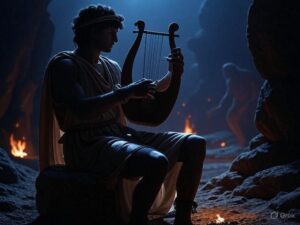
Orpheus, a gifted musician and poet, son of the Muse Calliope and Apollo, possessed a lyre whose music could charm all living beings and even move the inanimate. He fell deeply in love with Eurydice, a wood nymph, and they married. Tragically, on their wedding day, Eurydice was bitten by a viper and died, descending to the underworld.
Devastated, Orpheus resolved to retrieve her. Armed with his lyre, he journeyed to Hades, the realm of the dead. His music softened the hearts of Charon, the ferryman, Cerberus, the three-headed guard dog, and even the stern judges of the underworld. When he played before Hades, the god of the underworld, and Persephone, his queen, their cold resolve melted. Moved by his lament, they agreed to release Eurydice, but with a condition: Orpheus must lead her out without looking back until they reached the upper world.
Orpheus began the ascent, Eurydice following silently behind. As they neared the surface, doubt crept in, had she truly followed? Unable to resist, he glanced back, only to see Eurydice fade back into the shadows, lost forever. Heartbroken, Orpheus wandered, his music now a mournful echo. Eventually, he was torn apart by the Maenads, frenzied followers of Dionysus, jealous of his devotion to Eurydice. His head and lyre floated down the river Hebrus, still singing, and were placed among the stars as the constellation Lyra.
Like Orpheus descending into Hades, we are asleep and sleepwalking through an existence of dream-like drama, lost in the shadows of our physical, mental, social, and cultural scripts. In this underworld of waking life, we mistake the fleeting shadows of our perceptions, shaped by biases and delusions, for reality, much as Orpheus trusted his music to navigate the dark. Yet, The Dreaming Kosmos invites us to ascend, like Orpheus emerging into daylight, to awaken to lucidity, a polycentric awareness that thins the self through empathy and reciprocity, serving others by aligning with the emergent flow of a harmonious, naturalistic universe. This journey asks: How is life dream-like? What delusions cloud our path? How do psi phenomena like telepathy and precognition, and mystical oneness reveal our emerging potentials? How can a dream yoga, like Integral Deep Listening (IDL), foster healing, balance, and transformation to align with our life compass, the evolving priorities guiding personal and collective growth?
These questions drive us to seek meaningful lives that enrich humanity, leaving a better world for future generations.
Psi phenomena and reincarnation captivate us for their transformative power, as seen in a young Indian girl recalling a weaver’s life, verified by distant elders, or Lawrence Anthony’s elephants trekking to honor his 2012 death.
The term “Kosmos,” was used by the Greeks to describe an ordered whole, transcending the material “cosmos.” It is used here to describe a naturalistic, evolutionary web where dreams and psi reveal interconnected potentials. Orpheus’s journey mirrors this: our dreams, analogous to his music, pierces Hades’s veil, accessing transpersonal illuminations at the edge of chaos, leading to oneness with the divine light of the upper world.
The Underworld of Waking Life
Waking life is Orpheus’s descent into Hades, a dream-like immersion where thoughts, emotions, and actions form attractor basins, whirlpool-like patterns stabilizing our identity in the realm of waking delusion. Like shadows on Hades’s walls, we trust our perceptions as real, yet they are shaped by misconceptions of control, such as overworking to avoid failure, invulnerability, or by debt-fueled spending fueled by consumption-driven worth. In this shadowy realm we are also misled by collective, dreamlike delusions of technological salvation or conflict-justifying national superiority, which further bind us, requiring 1.7 Earths for global U.S. living standards. In The Dreaming Kosmos, identity is not a fixed substance but a fluid process, a river crossing from turbulent dreams to a clear shore of lucidity, as Orpheus seeks Eurydice but finds deeper truths.
Dreams as Portals to the Transpersonal
Dreams are Orpheus’s music in Hades, a portal dissolving boundaries of self, time, and space, revealing the transpersonal and mystical oneness. Like the Aboriginal Dreamtime’s Rainbow Serpent carving rivers, dreams weave chaotic potentials into coherent narratives, accessing humanity’s emerging potentials. A 2023 Pew survey notes 46% of U.S. adults report dream visitations from deceased loved ones, echoing Ian Stevenson’s 2,500 reincarnation cases, with 35% showing correlated birthmarks. In 1988, at the Association for the Study of Dreams’ telepathy experiment, my dream of a man wrestling a snake mirrored the target image, Laocoön and His Sons, suggesting synchrony via brain rhythms like Theta waves (4–8 Hz).
Dreams reflect life’s full spectrum of fear, conflict, and joy, raising the challenge: how do we discern veridical knowledge from projections? The snake could be a biblical tempter, Jungian shadow, or transpersonal link to Laocoön, requiring IDL’s empathetic multi-perspectivalism to embody its perspective, thinning the self into a collective web. Like Orpheus’s lyre harmonizing Hades, dreams bridge waking delusions to transpersonal potentials, aligning with the veil of Hindu maya lifting to reveal Brahman’s oneness or Ra’s rebirth from the underworld’s chaos.
The Ascent to Lucidity
Wakefulness is Orpheus’s ascent from Hades and Plato’s ascent from firelit shadowy imprisonment, emerging into sunlight, seeing life’s interconnected tapestry with clarity. In The Dreaming Kosmos, lucidity is much more than personal enlightenment. It is based on waking and dreaming collective polycentrism, embracing multiple perspectives to counter delusions, like the kaleidoscope turning to reveal harmonious patterns. IDL’s dream yoga is one approach to amplifying lucidity. It interviews dream characters, such as a squeezing anaconda, to cultivate meta-awareness, aligning with the priorities of your innate life compass, emerging at the edge of chaos. Negentropy generates order from chaos. AQAL’s tetra-mesh, as subjective “I,” cultural “We,” neural “It,” and systemic “Its” in balance, generates higher functioning holons that give processes the stability and adaptability necessary both for biological, personal, cultural, and social evolution. For example, becoming and interviewing a dream attacker reframes fears, fostering collective healing through empathy. Becoming Putin or Netanyahu internalizes and owns the feared or rejected “other” as an intrinsic part of ourselves, while generating new objectivity via empathy with their perspectives.
Why Emphasize the Collective?
“Most people think sequoias survive because they’re massive.
But that’s not even close to the real reason.
If you’ve ever had the privilege standing beside one of these giants, you’ll find it hard NOT to think of resilience.
These trees can live through droughts, fires, storms, and climate shifts that would kill almost anything else.
But as an engineer this is what I’m fixated on:
The tallest tree in the world has roots that only go 6-12 feet deep.
That should be impossible. A 300-foot tree with shallow roots makes no sense from an engineering perspective.
But… Sequoias don’t survive alone.
Their root systems spread 50-80 feet wide and interweave with every other sequoia around them.
They share nutrients, water, and structural support. When storms come in, they support each other.
The forest is the system: Not the individual trees.
I couldn’t stop thinking about this.
Most people try to build resilience by making themselves bigger, stronger, more independent. They stockpile resources, they build higher walls, they go it alone.
But the most resilient systems in nature are interconnected.
Maybe the question isn’t “how do I become more self-sufficient?” but “how do I become more meaningfully connected to the right systems?”” – Rob Avis
Transformational Experiences of Oneness
Orpheus’s journey reflects four varieties of oneness, each driving evolutionary emergence with strengths and pitfalls, accessible through IDL’s polycentric practice:
Oneness with Nature: Orpheus’s music communes with trees and rivers, dissolving into nature’s flow, like Theta meditation (4–8 Hz) amplifying ecological bonds, such as Anthony’s elephants and accessing psi. But like Icarus, one can easily fly too high, based on grandiosity from unregulated input, information, power, and energy. How do we gain the objectivity to recognize our grandiosity? One function of IDL interviewing is to provide a reality check on our motivations, intentions, preferences, and assumptions.
Oneness with the Divine (Subtle Mysticism): Orpheus’s lyre invokes divine muses, offering purpose, like Christian visions or Tibetan deity yoga. IDL interviews, such as with a dream cactus or spittoon, dismantle dualism, fostering polycentrism. But divine clarity too easily fossilizes into dogma. IDL avoids this by embracing both secular and sacred perspectives.
Oneness with the Formless (Causal Mysticism): Orpheus’s silence in Hades’s depths mirrors formless awareness, like Zen satori, promoting detachment. But the quest for enlightenment easily leads to withdrawal and a failure to support the ills of society. IDL counters this tendency with yoga: practical application in daily life.
Oneness with the Non-Dual: How do we integrate the ultimate, unconditioned kosmos into the dualistic world of shadow and drama? Orpheus’s ascent, uniting self and other, reflects non-dual awareness, like Dzogchen’s sunyata, as a byproduct of polycentrism, not a pinnacle of personal enlightenment. IDL grounds transformation at the edge of chaos in core relational behaviors of respect, trustworthiness, empathy, and reciprocity.
Transformational experiences of oneness risk not only grandiosity but addiction to transcendence. The history of Hinduism and Buddhism show no necessary correlation between personal awakening and collective good. The Dreaming Kosmos prioritizes balance over higher states, stages, and developmental lines, uplifting macrocosmic and microcosmic collectives through polycentrism, not individual enlightenment, as Orpheus’s failure to retrieve Eurydice warns against clinging to personal goals, urging service to the collective web.<sup>30</sup>
The Kosmic Dream: A Naturalistic Vision
Life is Orpheus’s song, a dream-like narrative weaving stable patterns like whirlpools, called attractors via negentropy, as in chaos theory. Dreams, like his music, are microcosms of the Kosmic web, spanning AQAL’s quadrants: subjective dreams, cultural narratives, neural systems, and cosmic patterns. Psi phenomena, such as Swedenborg’s 1759 clairvoyant vision of raging fire destroying Stockholm, are naturalistic, emergent properties, potentially falsifiable through neural studies, not supernatural ends, but means to collective transformation. The supernatural-materialist divide is partial; The Dreaming Kosmos synthesizes both, fostering respect for diverse experiences and reciprocity in inquiry.
What The Dreaming Kosmos is Not
The Dreaming Kosmos stands at a threshold between two exhausted paradigms, materialism and idealism. Each is correct in what it affirms and incomplete in what it denies. Reductionist materialism insists that only the measurable is real while idealism insists that reality is fundamentally mind. The first blinds itself to experience, the second to embodiment. The view advanced here attempts neither to escape between them nor to synthesize them into a higher abstraction, but to re-situate both as partial perspectives within a selfless organizing, participatory universe.
The Dreaming Kosmos is not a claim that the universe literally dreams or awakens. Dreaming and awakening are metaphors pointing toward the experiential truth that the universe is not inert but alive with process, indeterminacy, and self-relation. To dream is to generate novelty. To awaken is to achieve coherence. In that sense, evolution itself is the cosmic movement between dream and awakening, between creative emergence and integrative realization.
To describe the universe as learning is not to anthropomorphize it, but to recognize that adaptation, from the cell to the ecosystem, is a form of learning. Organisms and systems register difference, respond to novelty, and retain successful patterns. In other words, they know. From the perspective of Extended Evolutionary Synthesis and developmental systems theory, learning and evolution are not separate but continuous processes of self-modifying adaptation. What humans call “mind” is one local intensification of that broader capacity.
This view aligns not with metaphysical idealism but with enactive naturalism, a lineage that includes Gregory Bateson, Francisco Varela, Ilya Prigogine, Lynn Margulis, Stuart Kauffman, and Michael Levin. Each, in different language, has described life and evolution as creative, selfless organizing, and open-ended, a process that transcends the mechanical without departing from nature. Levin’s work on Technological Approach to Mind Everywhere (TAME) extends this principle: mind is not a substance but a functional property of systems capable of sensing, acting, and regulating toward goals. Such mind need not be human, or even neural. Levin’s work demonstrates the critical role bioelectrical homogenesis plays in healing and evolutionary emergence. The Dreaming Kosmos postulates an empirical holistic naturalism and integral realism grounded in selfless organization, adaptation, and energy utilization.
From this vantage, self-awareness is not an inexplicable metaphysical leap but one irreducible dimension of reality, the interior of holons, the Upper-Left of the AQAL map. To deny its reality is no less metaphysical than to assert that only matter exists. Awareness is one face of nature, as gravity is another.
To call this universe sacred is not to return to theology but to recover reverence for an immanent creativity that is at once intelligible and mysterious. “Divinity,” if one must use the term, ceases to be a transcendent architect and becomes the interior resonance of relational intelligence, what older traditions called logos, what contemporary science glimpses as selfless organizing coherence.
This work, then, does not argue for a cosmic mind behind the world, but for a world that is capable of meaning from within itself. It is an invitation to participate in that meaning, to awaken within the Dreaming Kosmos.
Core Questions and Answers
Why Do We Think We’re Awake When Dreaming? The default mode network projects waking identity into dreams, blurring realities, as Orpheus trusts his lyre’s reality.
How Is Waking Life Similar to Dreaming? Waking assumes objectivity, such as justifying a bad relationship, binding us to delusions, countered by polycentrism’s multi-perspectival clarity.
What Are Our Major Delusions? Our individual delusion of separateness and collective delusions of groupthink, like Hades’s shadows, view identity as substance, not process.
Why Recognize Partiality? Black-and-white, dualistic thinking divides us from others; polycentrism, like Orpheus’s ascent, fosters empathy and non-dual awareness.
What Are the Four Pillars of Delusion? Cognitive biases, sensory overload, narrative continuity, and lack of meta-awareness sustain delusions, pierced by IDL’s interviewing.
How Do We Compensate? Interviewing dream elements, such as a squeezing anaconda, the personifications of our life issues, such as a crocodile embodying procrastination, or your deceased grandmother, experienced in a visitation, cultivates meta-awareness, aligning with the life compass for personal collective healing, balancing, and transformation.
What Emerging Potentials Await? Transpersonal emerging potentials and mutually respectful relationships with both waking and dreaming others, facilitated via IDL, drive transformation, aligning with the Kosmic web’s harmony.
Conclusion: Orpheus’s Song of Awakening
The Dreaming Kosmos reimagines reality as a naturalistic tapestry, weaving minds, cultures, and systems via negentropy and attractors. Like Orpheus, we navigate the dream-like underworld of our waking lives, using dreams as portals to both empirical clarity and oneness, ascending to lucidity through polycentrism. By practicing IDL, we align with our life compass, fostering collective harmony and a balanced future, ensuring Orpheus’s song resonates for humanity’s awakening.
Possibilities for Research
Claim: In a 1988 Association for the Study of Dreams telepathy experiment, a dream of a man wrestling a snake mirrored the target image (Laocoön and His Sons), suggesting synchrony.
• Verification: No public records or studies confirm this specific 1988 experiment or the personal anecdote. Searches yield only art history on the sculpture, not dream telepathy events. This may be an unverified personal story.
• Proposed Experiments:
• Ganzfeld-Style Dream Telepathy Replication: In a double-blind setup (n=50 pairs), one “sender” views a random image, such as Laocoön or similar) during waking hours, focusing on it. The “receiver” sleeps in a sensory-isolated room, records dreams upon waking. Independent judges rate dream-image matches (0-100 scale). Validation if hit rate >25% chance (p<0.01 via binomial test); falsification if at chance levels. Use EEG to monitor sleep stages.
• Group Experiment at Conferences: At a modern ASD conference, randomly assign 100 participants to sender/receiver roles with target images. Analyze dream reports for thematic matches, such as snakes, wrestling). Control for prior knowledge; falsify if no above-chance correlations.
Claim: Dreams involve theta waves (4–8 Hz) that enable synchrony, telepathy, or transpersonal connections, such as in meditation or dream states).
• Verification: Theta waves (4-8 Hz) are associated with drowsiness, meditation, and REM sleep, aiding relaxation and creativity. However, no robust evidence links them to telepathy or interpersonal synchrony; results show mostly audio tracks for sleep induction, not scientific studies.
• Proposed Experiments:
• EEG Synchrony Study: Pair 40 participants (sender/receiver) in separate rooms. Induce theta states via binaural beats (4-8 Hz audio). Sender visualizes a simple image; receiver meditates/dreams. Measure inter-brain EEG synchrony (phase-locking value). Validation if theta synchrony correlates with accurate image guesses (>chance); falsification if no difference from control (non-theta audio).
• Meditation Group Sync: In groups of 10, induce theta via guided meditation. Test pre/post for “transpersonal” effects, such as shared dream reports or empathy scores via questionnaires). Use fMRI to scan brain activity; falsify if no theta-specific group effects beyond placebo.
Claim: Psi phenomena, like Swedenborg’s 1759 clairvoyant vision of the Stockholm fire, are naturalistic and falsifiable through neural studies.
• Verification: The Swedenborg anecdote is historically documented as a reported clairvoyant event during the 1759 Stockholm fire, though unproven scientifically.
• Proposed Experiments:
• Remote Viewing Protocol: Using Rhine Institute methods, test 50 participants in blinded trials: Describe a distant event, such as a controlled “fire” simulation 300 miles away). Rate accuracy via judges. Validation if hit rate >chance (p<0.05); falsification if explained by leaks or coincidence. Include fMRI to scan neural correlates during “visions.”
• Neural Correlates Study: Use EEG/fMRI on 30 self-reported clairvoyants during tasks mimicking Swedenborg, such as describing hidden events). Compare to controls. If unique patterns, such as theta/gamma bursts) predict accuracy, validate naturalistic basis; falsify if no differences or all at chance.
Claim: Integral Deep Listening (IDL) practices, such as interviewing dream characters) cultivate meta-awareness, empathy, and collective healing, reducing delusions and fostering polycentrism.
• Verification: IDL is a therapeutic approach with emerging studies showing effectiveness in adolescent mental health, comparable to mindfulness therapies. It promotes empathy and well-being, but large-scale RCTs are limited.
• Proposed Experiments:
• Randomized Controlled Trial (RCT): Assign 200 participants with anxiety/delusions to IDL (8 weeks of dream interviewing) vs. control (journaling). Measure pre/post via scales, such as Meta-Awareness Questionnaire, Empathy Quotient, Delusion Inventory). Validation if IDL group shows >20% improvement (p<0.01); falsification if no difference.
• Empathy Induction Test: Have 100 participants “interview” dream characters, such as a feared figure like “Putin”) vs. neutral writing. Test empathy via behavioral tasks, such as perspective-taking scenarios). Use pre/post fMRI for brain changes, such as mirror neuron activation); falsify if no empathy gains.
Claim: Dreams weave chaotic potentials into coherent narratives via negentropy (order from chaos), reflecting life’s spectrum and accessing emerging potentials.
• Verification: Negentropy (from chaos theory) applies to selfless organizing systems, but direct links to dreams are conceptual, not empirically proven in this context.
• Proposed Experiments:
• Chaos Theory Analysis of Dreams: Record dreams from 50 participants over 30 nights (via apps/journals). Apply mathematical models, such as Lyapunov exponents for chaos, entropy calculations). Validation if dream narratives show decreasing entropy (more order) over time; falsification if random/unchanging.
• Lucid Dreaming Intervention: Train 40 participants in lucid dreaming, such as via reality checks). Track “coherent narratives” via content analysis. Measure negentropy proxies, such as thematic stability). If lucid dreams show higher order, validate; else, falsify.
Broader Non-Empirical Claims, such as Waking Life as Dream-Like, Oneness Experiences)
• These are harder to test directly but could be indirectly probed:
• Brain Activity Comparison: Use EEG/fMRI on 30 participants during waking tasks vs. dreaming (via sleep labs). Test for similarities in default mode network activity (projecting identity). Validation if overlaps >70%; falsification if distinct.
• Oneness Meditation Study: Induce “oneness” via theta meditation or IDL (n=50). Measure pitfalls like grandiosity (via narcissism scales) pre/post. Validation if balanced practices reduce risks; falsify if they increase withdrawal.
These experiments prioritize ethical standards, such as informed consent, no harm) and could be conducted via institutions like the ASD or parapsychology labs. Results would refine or challenge the text’s synthesis of science and mysticism.
Practical Applications: Begin Your Transpersonal Dream Yoga
Record Dreams: Use outstanding and organic biofeedback to access subjective sources of objectivity.