
From Social Atoms to Dream Ecologies:
Dream Sociometry and Its Lineage in Moreno’s Sociometric Vision
Jacob Levy Moreno saw what most psychology of his time could not: that the fundamental unit of psychological life is not the individual mind, but relationship. Long before attachment theory, systems theory, or network analysis entered clinical language, Moreno recognized that suffering emerges where relational fields freeze, distort, or collapse. Sociometry was his method for making those invisible relational structures visible.
Dream Sociometry stands directly in this lineage. It does not repudiate Moreno’s work; it presupposes it. Dream Sociometry grew out of the application of Moreno’s sociometry to dreams and dreaming. At the same time, Dream Sociometry, as the seminal form of IDL, carries sociometric thinking into a domain Moreno intuited but never systematically mapped, the dreaming psyche as a living social field. In doing so, Dream Sociometry both extends and transforms sociometry, shifting it from the interpersonal to the imaginal, from observable groups to internal ecologies of perspective. By doing so, it integrates dreaming and waking, the other and the self, moving beyond habitual and adaptive dualisms to a recognition of the inherent, underlying non-duality of experience.
Moreno’s Core Insight: Relationship as Primary Reality
Moreno’s sociometry emerged from a deceptively simple clinical question: Who chooses whom? Beneath this lay a radical ontological claim, that social order arises from patterns of attraction, rejection, and indifference among individuals, not from imposed hierarchies or abstract roles. The sociogram did not explain these patterns; it revealed them.
For Moreno, pathology did not reside primarily inside individuals. It resided in positions within relational networks, who was excluded, who was burdened with unwanted roles, who was isolated or triangulated. Healing therefore required not insight alone, but reorganization of the relational field itself. This foundational assumption is carried intact into Dream Sociometry.
From External Groups to Internal Fields
Where Dream Sociometry diverges is not in principle, but in scale and location. Moreno mapped relationships among people in classrooms, hospitals, prisons, and communities. Dream Sociometry maps relationships among perspectives within a single psyche, dream figures, emotions, body states, imagined others, symbolic environments, and transpersonal experiences.
A dream is not treated as a narrative to be interpreted, nor as a symbolic code to be deciphered. It is approached as a social system. Dream figures relate to one another sociometrically: they ally, oppose, dominate, protect, avoid, or disappear. Some are central; others are marginalized or silenced. Power, fear, loyalty, and exclusion operate in dreams exactly as they do in waking groups. In this sense, a dream is not a story. It is a sociogram in motion.
The Dream Sociogram: Mapping Without Interpretation
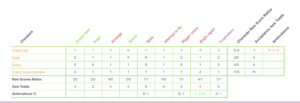
In Understanding the Dream Sociogram, Dream Sociometry formalizes this shift methodologically. The dream is first mapped, not interpreted. The clinician and dreamer ask sociometric questions rather than symbolic ones:
Who is present?
Who has agency?
Who approaches or withdraws?
Who is feared, ignored, or attacked?
These are the same questions Moreno asked of social groups. What changes is the domain. This suspension of interpretation is not a stylistic choice; it is a clinical necessity. Interpretation privileges the therapist’s meaning-making. Sociometry privileges the system’s own selfless organization. Dream Sociometry insists that before we explain a dream, we must understand its relational structure.
Role Theory Without Hierarchy
Moreno’s role theory held that the self emerges through roles enacted in relationship. Dream Sociometry accepts this fully, but it removes one assumption that remained implicit in much psychodramatic practice. Roles ultimately organize around a central ego or Self, from the perspective of our waking identity, which IDL calls “psychological geocentrism,” in recognition that normal perspectives, both awake and in dreams, relate all experience and others to a central, organizing identity. IDL takes a phenomenological perspective, meaning that it suspends the assumption that dream elements are roles or “parts” or “self-aspects” in favor of asking, “Dream element, how do you view yourself?”
In Dream Sociometry, no perspective is privileged in advance. No perspective is assumed to either be a role or not be a role. The dream ego is not the director. The monster, the child, the storm, the absent figure, all are treated as equal perspectives within a distributed system. This non-hierarchical stance is particularly critical in trauma work, where authority and centralization often replicate earlier relational injuries. Dream Sociometry does not aim to integrate interviewed perspectives into a coherent self-image. It aims to restore communication among them so that coherence can emerge organically.
“Role Reversal” Without Catharsis
Moreno’s most radical clinical tool was role reversal, the deliberate inhabiting of another’s position to restore spontaneity and empathy. Dream Sociometry retains a process akin to role reversal but releases catharsis as a goal. Dream Sociometry asks the dreamer to temporarily disidentify with “self” or identity in order to embody the perspective of the other, not as a role, but as itself, however it conceives of itself. That might be as role, self-aspect, autonomous other, all of those or none of those.
Regarding catharsis, when a dreamer speaks as a dream figure, the aim is not emotional discharge, insight, or correction. It is representation. The figure is allowed to speak from its own position, without pressure to change, soften, or resolve. Change occurs, when it occurs, not because emotion has been released, but because unrecognized and under-appreciated perspectives have been acknowledged, respected, and even honored by the application of their reframings in life as a form of dream yoga. This is sociometry at the edge of chaos: reorganization through inclusion rather than control.
Tele and Distributed Intelligence
Moreno’s concept of tele, the felt, mutual resonance between individuals, was his alternative to projection-based models of relationship. Tele was real, reciprocal, and emergent.
Dream Sociometry extends tele inward. Tele operates between dream figures, between waking identity and imaginal others, between present experience and developmental memory. The psyche becomes a field of distributed intelligence rather than a container of contents.
This is where Dream Sociometry departs most decisively from classical sociometry. The “group” under study is no longer composed of separate bodies, but of perspectives sharing, but not limited to, a single organism. They can and often do embody collective identity that extends beyond the integration of the psyche. Intelligence and experience itself are not localized; they are relational and emergent.
Clinical Implications: Trauma, Nightmares, and Frozen Fields
In trauma, sociometric fields, external and internal, tend to collapse around rigid survival roles. Dreams reflect this collapse with remarkable fidelity. Nightmares are not random disturbances; they are sociograms of exclusion, domination, and failed communication.
Dream Sociometry does not attempt to eliminate frightening figures. It restores relationship with them. When a child interviews a monster, or an adult speaks as a paralyzing fear, the system is not indulging fantasy. It is repairing a broken internal society. Moreno believed that societies heal by reorganizing roles. Dream Sociometry applies this belief at the level of the dreaming kosmos, which views dreaming as one manifestation of fundamental evolutionary processes.
Conclusion: Moreno’s Legacy, Extended
Moreno gave psychology a way to see relationship. Dream Sociometry gives it a way to see how relationship continues to organize itself when consciousness sleeps, before consciousness existed, with or without consciousness. It does not replace sociometry; it internalizes it. It does not improve upon Moreno’s vision; it fulfills one of its unrealized trajectories.
If sociometry revealed that individuals suffer because of their position in groups, Dream Sociometry reveals that we suffer because we are exiled from participation with our emerging potentials and what IDL calls our “life compass.” It is a hypothesized evolving process consisting of priorities that are fundamental not only to ourselves but to the cultural and social collectives that we belong, and which are attempting to emerge, as evolutionary potentials, into manifestation. Healing, in both cases, occurs when communication is restored and the field reorganizes itself.
Moreno taught us to map the invisible. Dream Sociometry listens when the invisible speaks back.