
How Do We Know What Is Real and True?
Integral Deep Listening, Quadrants, and Pragmatic Epistemology
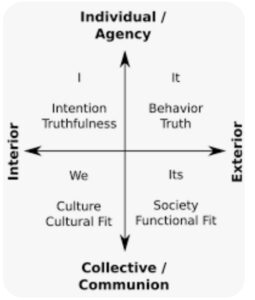
Integral Deep Listening (IDL) can be understood not only as a psychological or contemplative practice but also as a structured epistemological process. When examined through the framework of Integral Theory’s quadrants and the pragmatic philosophy of Charles Sanders Peirce, IDL reveals a coherent method for generating, interpreting, and evaluating experiential knowledge. The method combines phenomenological inquiry, polycentric interpretation, and pragmatic testing in a way that addresses both subjective insight and empirical credibility.
At the same time, certain aspects of its theoretical framing—particularly the placement of interviewed perspectives within the quadrants—raise important philosophical questions. Clarifying these issues strengthens the case for IDL as a rigorous naturalistic method of inquiry.
Phenomenology as UL Method Rather Than Ontology
In the above diagram “UL” stands for the “upper left” “I” quadrant of interior individual thoughts, feelings, and intentions. IDL begins with a phenomenological stance toward experience. When a dream character, object, or situation is interviewed, the practitioner temporarily suspends assumptions about its ontological status. The perspective is neither assumed to be a literal external entity nor reduced to a mere psychological projection.
Within the Integral framework, this stage belongs primarily to the Upper Left (UL) quadrant: the domain of first-person experience. However, IDL treats this UL activity primarily as methodology, not as a source of final truth claims. The purpose of interviewing perspectives is to generate descriptions and interpretations of experience rather than to establish metaphysical facts about what those perspectives “really are.”
This approach protects the practice from several common interpretive pitfalls:
•naive realism (assuming the perspective is literally real)
•reductive psychologism (assuming it is only a projection)
•spiritual inflation (assuming it represents higher guidance).
Instead, perspectives function as phenomenological standpoints through which experience can be examined.
Interpretations as LL Phenomena
A key point of debate concerns where the interpretations produced during interviews belong within the quadrant model.
Some interpreters of Integral Theory might argue that all material emerging during the interview remains within the UL because it occurs within individual experience. According to this view, interpretations only become Lower Left (LL) phenomena once they are shared socially.
IDL proposes a different interpretation.
Interviewed perspectives generate interpretations, and interpretation is by definition an intersubjective process. Even when those interpretations arise within a single individual, they involve relationships among multiple viewpoints. When several elements—such as different dream characters—offer their own interpretations of events, the result is not merely a sequence of subjective experiences but a field of interacting perspectives.
This field can reasonably be understood as an intrasocial collective within experience. In other words, multiple perspectives form a temporary interpretive community. Their interactions generate a network of meanings that resembles the dynamics of the LL quadrant, even though the participants exist within one individual’s experiential field.
From this standpoint, IDL treats the interpretations generated by different perspectives as subjective sources of objectivity. Each perspective contributes information that may challenge or complement the viewpoint of waking identity. The resulting set of interpretations forms a proto-intersubjective domain that can be evaluated and compared.
Cognitive Bias and Pragmatic Testing
A second criticism concerns the role of cognitive biases such as confirmation bias, narrative construction, and projection. Because interviewed perspectives arise within the practitioner’s own experiential field, skeptics may argue that the method risks reinforcing existing beliefs rather than generating new knowledge.
IDL does not deny that such biases occur. Instead, it addresses them through a two-stage validation process that emphasizes empirical testing in the exterior quadrants.
Interpretations produced during interviews are treated as hypotheses rather than conclusions. Their credibility is evaluated through observable consequences in behavior and relationships. In Integral terms, this evaluation occurs primarily in the Upper Right (UR) and Lower Left (LL) quadrants:
•UR validation involves observable behavioral outcomes and practical effectiveness.
•LL validation involves relational feedback and shared interpretation within communities.
Because interpretations must demonstrate usefulness in lived experience, purely subjective biases lose much of their importance. If a recommendation improves functioning, relationships, or adaptability, it gains credibility regardless of its origin. If it does not, it loses influence.
In this way, pragmatic testing renders many concerns about internal bias largely moot.
Self-Validation and Collective Validation
IDL also recognizes two complementary forms of validation: self-validation and collective validation.
Self-validation occurs when an individual tests a recommendation and experiences its effects directly. Personal experience plays an essential role in determining whether an interpretation is meaningful or effective.
Collective validation occurs when interpretations are examined within social contexts—through dialogue, shared practice, or feedback from others. Communities can challenge assumptions, provide alternative viewpoints, and help evaluate results.
Both forms of validation are necessary. However, they do not always lead to agreement. History demonstrates that collective consensus alone cannot compel individuals to abandon conclusions that differ from their personal experience. Likewise, purely private conviction can drift away from broader evidence if it remains isolated from communal testing.
IDL therefore relies on a dynamic balance between self and collective evaluation, recognizing that knowledge emerges through the interaction of both.
Parallels with Peirce’s Pragmatic Epistemology
The epistemological structure of IDL closely resembles the pragmatic philosophy of Charles Sanders Peirce, particularly his model of inquiry involving abduction, deduction, and induction.
Peirce argued that knowledge develops through a cyclical process:
1.Abduction – generating plausible hypotheses to explain experience
2.Deduction – reasoning about the implications of those hypotheses
3.Induction – testing the hypotheses through observation and experimentation.
IDL mirrors this sequence in several ways.
The phenomenological interview functions as a form of abductive generation. By speaking from different perspectives, the practitioner generates alternative interpretations of events. These interpretations function as hypotheses about what may be occurring psychologically, relationally, or developmentally.
Next, the practitioner considers the implications of these interpretations. Advice or recommendations from interviewed perspectives suggest potential behavioral adjustments or changes in priorities. This stage resembles deductive reasoning, in which the consequences of a hypothesis are explored.
Finally, these recommendations are tested in lived experience. Behavioral experiments, relational outcomes, and practical effectiveness provide inductive evidence regarding which interpretations are credible. Over time, those that repeatedly produce beneficial results gain greater confidence.
In this sense, IDL operates as a pragmatic cycle of inquiry, very similar to the model proposed by Peirce.
A Polycentric Epistemology
When viewed in this broader philosophical context, IDL can be understood as a polycentric epistemology.
Instead of assuming that waking identity possesses privileged access to truth, the method generates insights from multiple perspectives. These perspectives function as provisional contributors to understanding rather than authorities. Their interpretations are then tested through practical engagement with reality.
The resulting process integrates several modes of knowing:
•phenomenological exploration of experience
•dialogical interpretation among perspectives
•pragmatic testing through behavior and relationship.
Knowledge emerges not from a single center of authority but from the interaction of many viewpoints within a structured process of inquiry.
Conclusion
Integral Deep Listening provides a distinctive approach to knowledge generation that combines phenomenological exploration with pragmatic validation. By interviewing alternative perspectives, the method creates a temporary intrasocial field of interpretations that can be examined and compared. These interpretations function as hypotheses that are evaluated through observable consequences in behavior and relationships.
Although questions about quadrant placement and cognitive bias arise naturally, IDL addresses them through empirical testing in the exterior quadrants and through the complementary processes of self and collective validation.
When viewed alongside the pragmatic epistemology of Charles Sanders Peirce, the structure of IDL becomes clearer. The practice generates abductive hypotheses through phenomenological dialogue, explores their implications through reflective reasoning, and evaluates them through inductive testing in lived experience.
In this way, IDL operates as a naturalistic method of inquiry that remains compatible with multiple philosophical interpretations while grounding insight in practical results. Knowledge emerges not from metaphysical certainty but from the disciplined interaction of perspectives within experience and the ongoing testing of their consequences in the world.