
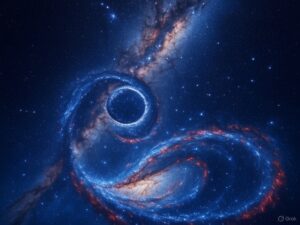
Feedback, Yin-Yang, and the Precipitation of Being
In the Dreaming Kosmos, existence flows like the Tao itself: selfless organization and adaptation are inseparable, each containing the seed of the other. To navigate this flux, Integral Deep Listening (IDL) offers a cybernetic framework, in which interviewing functions as an early-warning feedback system, detecting imbalances along the selfless organization/adaptation polarity, whether toward flooding or constipation. Dream Yoga, in turn, applies the recommendations emerging from these interviews, providing åa practical, experiential test of the adaptive appropriateness of responses, cultivating resilience and integration.
Viewed through the lens of yin and yang, selfless organization is yin: fluid, receptive, process-oriented, verb-like. Adaptation is yang: stable, structured, noun-like, and functionally coherent. The Tao reminds us that yin and yang are never absolute: every structure contains the potential for dissolution, and every flow contains the potential to crystallize. Between these poles lies precipitation, the threshold at which emergent potentials condense into enduring patterns, enabling evolutionary emergence.
While precipitation is observed on all levels of evolutionary emergence, as we have discussed in Precipitation and the Dreaming Kosmos, perhaps the clearest and most understandable example is weather. When humidity builds up in the atmosphere there is a maximum holding capacity. When that is reached a state transition spontaneously occurs in order to maintain system stability. Precipitation, in the form of rain, sleet, or snow is a necessary release to return the atmosphere to a stable, adaptive state. The humidity has to go somewhere when it can no longer remain humidity, and so it transforms into rain, sleet, or snow.
Rain, sleet, and snow contain the “seeds” of humidity, just as yang contains a kernel of yin. In time, with temperature changes, rain, sleet, and snow transform again into atmospheric humidity. Similarly, the “yin” of humidity contains the seed of “yang” form in its molecules of oxygen and hydrogen.
In evolutionary terms precipitation is a shift from selfless organization to adaptability. In dreams, it is the precipitation of dream characters and narratives. In waking life, it is the precipitation of feelings and thoughts into action. In culture, it is the precipitation of institutions like religion and government.
Why Anchor IDL in Evolutionary Dynamics?
Anchoring IDL Dream Yoga in evolutionary dynamics, especially in a mechanism like precipitation, is not an optional philosophical flourish. It is what makes the work coherent, grounded, testable, and ethically responsible. Without that anchoring, dream yoga easily drifts into symbolic play, spiritual bypass, or aesthetic introspection. With it, IDL becomes an applied evolutionary discipline.
Specifically, it performs eight different essential functions. 1) It grounds subjective experience in objective constraint, 2) it explains why not all insights should be integrated, 3) it integrates yin–yang without collapsing into relativism, 4) it explains why dream yoga is not therapy, spirituality, or self-improvement, 5) it creates an internal ethic without external authority, 6) it aligns IDL with systems, chaos, and complexity science, 7) it makes healing, balancing, and transformation intelligible stages, not promises, and 8) it honors the Dreaming Kosmos as intelligent but indifferent.
It grounds subjective experience in objective constraint
Dreams, visions, and altered states are intrinsically seductive. They are rich, fluid, and meaning-generating. But evolution reminds us of a hard truth: Experience alone does not justify itself. Only what precipitates into adaptive function survives. Precipitation provides the missing criterion: Does this insight hold? Does it stabilize behavior? Does it increase resilience across contexts? Does it reduce unnecessary suffering without reducing adaptive capacity? This is why intuition and mystical experiences, as transformative as they may be, are not enough from an evolutionary, or even from a four-quadrant holonic perspective. Objectivity provides necessary grounding in lasting adaptability.
By anchoring IDL dream yoga in evolutionary dynamics, subjective experience is submitted to selection pressure. This protects the work from becoming merely expressive or self-referential. Dream yoga becomes not “What did I experience?” but “What can now function?”
It explains why not all insights should be integrated
A central danger in depth and transpersonal work is premature integration. Evolutionary framing clarifies by demonstrating that many emergent potentials are exploratory mutations in which most are not meant to stabilize. Serendipitous occurrences or precognitions disassociated from any personal relevance, leaving one at a loss as to what to do about them are examples. Selection, not intensity, determines value for evolution. Insight, intuition, and catharsis, regardless of how meaningful, also do not determine value from an evolutionary perspective. Survival under conditions of objective constraint does. Precipitation distinguishes noise from signal, flooding from emergence, and destabilization from transformation.
IDL interviewing functions as an early-warning system, detecting whether the psyche is too fluid, that is, flooded, dissociated, or overwhelmed, or too rigid, that is, constipated, defended, or ossified. Dream yoga then becomes a safe experimental arena, where emergent potentials are tested, not assumed to be truths.
It integrates yin–yang without collapsing into relativism
Without evolution, yin and yang risk becoming poetic metaphors. With evolution, they become functional necessities. Yin as selfless organization generates novelty while Yang as adaptation ensures survival. Precipitation governs the traffic between them.
Evolution gives teeth to the Tao. Flow must eventually carry weight or it dissolves. Structure must eventually yield, or it fractures. IDL dream yoga trains practitioners to feel this boundary, not intellectually but somatically, emotionally, and behaviorally.
It explains why dream yoga is not therapy, spirituality, or self-improvement
Anchoring in evolutionary dynamics makes clear that IDL dream yoga is none of these, yet all of them only insofar as they serve adaptation. IDL dream yoga is not therapy because symptom relief alone is insufficient. It is not spirituality because transcendence without integration is maladaptive. It is not self-help because self-optimization is not evolution. IDL asks a more demanding question: “What configuration of selfhood best supports ongoing emergence within real constraints?” Precipitation answers that question operationally.
It creates an internal ethic without external authority
Evolution supplies a non-moralizing ethic by asking, “What stabilizes without constricting?” “What opens without flooding?” “What increases coherence across quadrants?” Anchoring in evolutionary dynamics prevents guru inflation, interpretive dominance, and ideological capture. The system itself becomes the teacher.
It aligns IDL with systems, chaos, and complexity science
Precipitation maps cleanly onto attractor basin formation, phase transitions, self-organized criticality, and adaptive landscapes. This gives IDL explanatory power beyond psychology, situating it within a larger scientific cosmology without reducing experience to mechanism.
It makes healing, balancing, and transformation intelligible stages, not promises
Evolutionary anchoring explains why. Healing becomes the reduction of maladaptive constraints so process can re-enter. Balancing becomes regulating oscillation between flow and form. Transformation becomes successful precipitation of new adaptive holons.
These are not ideals or endpoints but functions in an ongoing evolutionary cycle. Without precipitation healing becomes endless catharsis, balancing becomes static harmony, and transformation becomes fantasy. With precipitation, change earns its right to persist.
It honors the Dreaming Kosmos as intelligent but indifferent
Finally, evolution protects the work from romantic cosmology. The Dreaming Kosmos is creative, but it is not benevolent. It generates endlessly, but it selects ruthlessly. IDL dream yoga, anchored in precipitation, teaches humility. Not everything that arises is meant to remain. Not everything that dissolves is a loss. This stance is deeply humane, paradoxically compassionate, and psychologically sane.
In short, anchoring IDL dream yoga in evolutionary dynamics such as precipitation is essential because it converts experience into function, protects against flooding and rigidity, grounds Taoist polarity in real constraint, provides an internal ethic without authority, makes transformation testable rather than aspirational, and situates IDL within a living cosmology, not a belief system. It ensures that dreaming serves life, rather than replacing it.
Yin: Selfless Organization and the Flow of Becoming
Yin is the receptive, soft, and fluid pole. In the weather analogy, it is the build-up of humidity in the atmosphere. In IDL, it is expressed in raw, unstructured, subjective experience: dreams, bodily sensations, fleeting thoughts, and relational dynamics that have not yet stabilized into identity or habit. Selfless organization is inherently indeterminate, a dynamic field of possibility.
How do these concepts concretely relate to our everyday physical, emotional, thought-based, relationship, and existential concerns? For example, you notice tension in your shoulders that appears whenever you attempt to “perform” in social settings. Interviewing reveals that this tension emerges precisely when the selfless, exploratory aspects of your being are suppressed by over-identification with roles.
You discover that recurring stress and anxiety surfaces when you attempt to anticipate or control outcomes. Through IDL interviewing, you come to recognize this pattern as a feedback signal indicating over-dominant adaptation (yang) constraining selfless play (yin).
In your creative life you sometimes find yourself stuck in habitual problem-solving strategies, unable to conceive alternatives. The interview process surfaces latent ideas and associations that you had ignored, allowing for your testing of these emerging potentials through Dream Yoga exercises.
In your relationships you realize that you tend to take what others say or do personally, even when, upon reflection, you recognize it probably wasn’t about you at all. By interviewing perspectives that personify your personalization, for example, as Chicken Little over-reacting to an acorn falling on your head, you learn to de-sensitize and test that less defensive approach in your waking relationships.
You also notice that feelings of emptiness or meaninglessness can emerge when your life runs smoothly but without much purpose or direction. Selfless organization has too much freedom without anchoring in adaptive structures. Your interviewing of dream elements identifies these moments as part of the feedback loop, providing you with new sources of authentic life meaning that generate a higher octave of balanced stabilization.
Yang: Adaptation and the Stabilization of Form
Yang is the active, structured pole. In the weather analogy, it is the transformation to rain, sleet, or snow. Adaptation manifests as established identities, habits, and functional patterns that allow life to proceed effectively. Adaptation provides continuity, coherence, and predictability. It generates slowed down processes that appear as things, substances, and holons. Left unchecked, things can become rigid, preventing the emergence of new capacities.
To apply yang as the adaptive pole of precipitation to your everyday reality, imagine that you experience excessive posture or muscular rigidity in response to stress. This reflects adaptation’s overreach. Exercise, particularly hatha yoga, as well as various forms of body work, are designed to support precipitation, a more complete movement from yin containment to yang release.
Imagine that you notice that you sometimes suppress your emotions to maintain social harmony. This can prevent authentic affect from surfacing, causing it to build up to explosive levels that you can later regret. Interviewing personifications of such emotions and then applying their recommendations as a form of Dream Yoga facilitates experiencing these emotions safely, integrating them into adaptive patterns that can coexist with social responsibilities.
Typically, in the routines of daily work and activities, a habitual decision-making framework solves repetitive problems or duties efficiently but stifles creativity. Interviewing dream elements or personifications of these problems uncovers underutilized cognitive potentials, and Dream Yoga allows experimentation with novel problem-solving strategies.
We tend to relate to others through stereotypes, habit, expectations, or past experience. All of these represent frozen adaptations. They are adaptive, but frozen nonetheless. Interviewing aspects that are frozen, like a fixated expectation of how our partner is “supposed” to treat us manifesting as say, an ironing board. By interviewing it we may find that we reframe our experience of our partner in ways that communicate in a more empathetic way.
If you find yourself having strong identification with your role or narrative self, like parenting or career performance, that can generate existential anxiety if disrupted by firing, health concerns, or deaths. Dream Yoga exercises provide a field for testing new relational and narrative structures, verifying resilience and appropriateness, leading to a higher order integration.
Precipitation: Cybernetic Integration Between Yin and Yang
Precipitation is the mechanism through which selfless potentials crystallize into adaptive form. It is both natural and intentional: a feedback-informed moment of integration. Dreams normally provide only a partial, limited release of systemic build-up. While they release the precursors of waking identity, as feelings, thoughts, and behavior into dream forms and narratives, dream precipitations rarely release their crystallization in waking life as habits, expectations, fixed preferences, misperceptions, emotional dramas, and toxic script injunctions, addictions, and delusions. In order for that to happen, waking awareness has to stay out of the way while the release process is happening and a new state of higher order selfless organization is forming. This rarely happens, mostly for scripted adaptive reasons.
Because our default waking perspective tends to be focused on stability, survival, and control, interviewing, or becoming interviewed perspectives in the course of our daily activities, is often not easily experienced as adaptive. In fact, it is more likely to be perceived as a direct threat to waking stability, control, and survival. The result is that rigid waking structures chronically dam the natural oscillation between yin build-up and yang release, generating states of systemic imbalance that undermine balance and health.
When the yoga is followed and the recommendations of interviewed emerging potentials are allowed to take the lead, this is, by analogy, the Taoist middle way, the point where yin informs yang and yang channels yin, producing patterns that are both emergent and functional.
The feedback loop can be summarized as 1) allowing state change to occur by getting out of the way and allowing a fully embodied alternative perspective to become figure in awareness; 2) sustaining the precipitation by remaining in that altered perspective during the interviewing process; 3) repeating what has been said and experienced as a way of generalizing a different perspective into our waking experience. This is analogous to keeping the flood gates open, allowing water, when it rains and thereafter, to irrigate crops; 4) Choose a recommendation to operationalize and test in order to ground and generalize dreaming yin selfless organization in waking precipitation. 5) Patterns that demonstrate adaptive resilience crystallize, reinforcing both structure and openness.
Verb/Noun Bias and the Tao of Cognition
Lakoff and Johnson highlight our cognitive preference for nouns, solid, fixed forms, over verbs, processes, and flux. This bias mirrors an overemphasis on yang: stability, identity, and function. Yet the Tao reminds us that every fixed form contains the seed of its opposite, and every flow contains the potential to crystallize. In IDL, cultivating awareness of verbs ensures that selfless process informs adaptive structure, sustaining both flexibility and coherence across all AQAL quadrants.
Conclusion: Oscillation as a Taoist-Evolutionary Strategy
In the Dreaming Kosmos, life evolves through oscillation, not opposition. IDL interviewing functions as a cybernetic early-warning system, detecting deviations along the yin-yang continuum of selfless organization and adaptation. Dream Yoga applies, tests, and integrates these potentials, producing precipitation and reinforcing resilience.
Healing arises in attentive receptivity to raw experience; balancing cultivates harmonious integration of process and structure; transformation manifests as the intentional crystallization of adaptive potentials. This cyclical, Taoist-informed framework provides not only therapeutic efficacy but also an applied cosmology, showing how the Dreaming Kosmos can be navigated intelligently, gracefully, and creatively.