
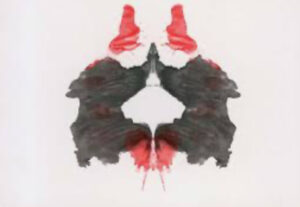
Life is a Rorschach test. Each of us gazes into the inkblot of our experience. We draw out patterns that mirror our assumptions. We can and will project onto the ambiguity of our experience whatever assumptions we hold because our survival depends on it. This tendency to perceive order in the formless has a name: pareidolia. We see constellations in random stars, faces on Mars, the “man in the Moon.” We turn clouds into animals and chance into fate.
Nowhere is this more evident than in our dreams. Because they resist our waking logic, we try to make them behave, to fit them into our familiar stories about who we are and what the world means. It’s as if, while dreaming, we become both artist and inkblot, interpreter and projection. Because our dreams are both extraordinarily personal and enigmatic. That things so strange and foreign or non-sensical could arise out of us threatens our sense of control, organization, stability, and security and demands some sort of response.
The Lens of Assumption
Our waking assumptions shape how we interpret what dreams reveal. Whatever our worldview, religious, psychological, scientific, or mystical, becomes the lens through which we look at the dream world. A priest may find divine messages; a therapist may find childhood symbols; a scientist may find neurological residue. Each reading mirrors its interpreter more than the dream itself.
This is the eternal dance of Hermes and Apollo, the Greek twins of ambiguity and order. Hermes is the trickster of flux and change; Apollo is the god of clarity and reason. Between them, meaning is born: a shimmering alloy of uncertainty and understanding.
Dreams as Pareidolia
If left to our natural instincts, we interpret dreams through naïve realism, the belief that what we see is real, like the sun rising and setting. Encounter a monster in a dream, and we flee or fight as though it could kill us. Because we usually believe we’re awake while dreaming, we apply the logic of waking survival to the logic of the dream. But dreaming plays by other rules. Applying waking assumptions to dreams distorts their meaning. It’s like mistaking constellations for maps of heaven.
Just as entire belief systems like astrology, numerology, and conspiracy, theories have been built on pareidolia, our private worlds become echo chambers of projected meaning. We see what we expect or fear to see.
Four Ways of Seeing
Ken Wilber’s Integral AQAL map offers a useful compass for understanding the many ways we interpret dreams. It divides experience into four quadrants:
- Interior Individual (I) , our inner thoughts and dreams.
- Exterior Individual (It) , our behavior and biology.
- Interior Collective (We) , shared values and culture.
- Exterior Collective (Its) , the systems and structures of society.
Each quadrant hosts its own kind of pareidolia.
In the “I” quadrant, we confirm our biases to defend our identity.
In the “It” quadrant, we reduce the dream to brain chemistry or call it shamanic travel.
In the “We” quadrant, we build cultural myths of religion, consumerism, or nationalism.
In the “Its” quadrant, we impose meaning onto history and nature: destiny, progress, or apocalypse.
Even integral theory itself, like every worldview, is not immune. All interpretations are, in some sense, refined pareidolias.
The Humility of Not Knowing
The wise response to pareidolia is not denial but awareness. We will project; that’s part of being human. What matters is recognizing the pattern. Even our best truths are temporary. Newton’s equations still guide the planets, but Einstein’s relativity reframed them. Theories evolve; so must we. Our cognitive biases spin sophisticated dreamlike fictions that order the unknown until a deeper order emerges.
The question, then, is not how to stop projecting but how to triangulate our projections, to cross-check them against other perspectives, both subjective and objective.
Triangulation and the Integral Deep Listening Approach
Integral Deep Listening (IDL) was developed to help us step outside the echo chamber of our own interpretations. It does this through triangulation: comparing our personal insights with the input of objective sources, such as science, experts, or AI, and subjective sources of objectivity, such as dreams and interviewed emerging potentials.
While objective sources reflect collective experience, subjective ones express the selfless organizing intelligence of evolution itself. Neither is “truth” in any final sense, but together they sketch a more reliable picture of reality. Triangulation doesn’t end projection; it simply helps us map its edges.
Our most likely response is to assume our waking assumptions about our dreams are correct. The lens through which we understand any particular dream is likely to be how we have come to think about who we are, why we are here, what we hope for, and what we fear.
A Dream from the River
Let’s ground this in an example.
A seventy-year-old man, let’s call him Paul, dreamed that two women asked for help finding an ancient Roman tunnel beneath the Mainz River in Germany. He borrowed a cousin’s dinghy to cross, but woke disturbed, unsure why.
In our session, we chose to interview not the women or the tunnel, but the river itself. The river, after all, flowed through everything in the dream. When interviewed using the IDL protocol, the river said:
“I like myself. I flow freely through beautiful countryside and support life and recreation.
But I’m uneasy about the tunnel, what might be hidden there? Could it undermine me?
I want to become a lake, serene, surrounded by trees and people enjoying themselves.
If I were Paul, I’d stay calm, not react to others’ drama, and flow through life untroubled.
I have no fear of aging or forgetting. I am timeless.”
In that moment, the river evolved into the lake, an act of selfless organization, transforming turbulence into stillness.
The lake suggested the river collapse into the tunnel and flush it out.
Suspending Interpretation
Our reflex is to rush in with symbolic readings: The tunnel is the unconscious! The river is the life force! The women are anima figures!
IDL asks us to suspend such interpretations. If we already knew what the dream meant, we wouldn’t need to ask. The goal is to listen, to allow the dream’s own perspectives to speak before our preconceptions drown them out.
This is why IDL treats dreams, fears, and even mystical experiences as living perspectives that can be interviewed. Each one reflects an emerging potential, an aspect of the self trying to organize toward greater wholeness.
From Insight to Practice
IDL is less about understanding dreams than about embodying their wisdom. When Paul speaks as the river or lake, he temporarily steps outside the habitual identity that defines and confines him. This creates space for genuine reorganization.
The lake, timeless and serene, offers him a pattern of being that he can practice in waking life, especially when faced with drama or fear. Yet real change is not instant. Becoming the lake once in an interview doesn’t erase years of conditioning. Like yoga, IDL is a practice, a discipline of sustained awareness. Its aim is not escape but integration: to carry the calm of the lake into the rapids of daily life.
Living Beyond Our Pareidolias
Every interpretation we hold, whether scientific, mystical, political, or personal, acts as a pareidolia, a projection we temporarily inhabit. IDL invites us to try on new ones consciously, as experiments. How does it feel to live as the river, the lake, the tunnel? What new possibilities of being emerge when we do?
This is a form of evolutionary play: testing identities, reframing meanings, generating new attractor basins for consciousness. Like any experiment, it thrives on feedback from dreams, from life, from others. Certainty gives way to curiosity; control gives way to co-creation.
Partnership with Evolution
The Dreaming Kosmos views such experimentation as a partnership with evolution itself. When we suspend judgment and embody emerging perspectives, we participate in the universe’s own selfless organization. We move toward what chaos theorists call the edge of chaos, the fertile zone between order and disorder where creativity thrives.
To live this way is to practice wu wei, the Taoist principle of “action through non-action,” flowing with the current rather than against it. It mirrors the quantum dance between probability and form, the oscillation from which all emergence arises.
The Dreaming Kosmos
Ultimately, both IDL and The Dreaming Kosmos are Rorschachs too, beautiful, evolving pareidolias. They are not final truths but working hypotheses, open to revision as our understanding deepens.
The universe itself is not a dreaming mind in the process of waking up as that is an anthropomorphic projection onto reality. It may be closer to truth to say that humans replicate the innate selfless organization of evolution generating increasing objectivity in the form of emerging potentials. We project and perceive simultaneously, forever reinterpreting our own inkblots of matter, energy, and consciousness. Our task is not to decode the final meaning but to join the dream and participate in its unfolding.
At the edge of chaos, where pareidolia meets emergence, we discover something wondrous: The cosmos is not merely being; it is becoming, dreaming itself into ever more integral forms of selfless organization.
Further Implications
What does this experience mean for the man who dreamt it? Much depends on what he does next. An interview like this can open a window, but unless he continues to look through it, the view will fade. Most altered-state experiences vanish like morning mist unless anchored in practice. If he takes the lake and river seriously, if he recalls their calm when the day tightens around him, he may begin to notice small shifts: less reactivity, less personalization, a quieting of old dramas. There is the emerging potential of hidden and feared toxicity being flushed out of his life. Is that realistic or a fantasy? How can that possibility be put to the test?
Yet to make these changes last, he will need to return to the process again and again through more interviews, through daily reflection, through a commitment to treat this as yoga rather than therapy, as a way of living rather than an occasional exercise. Healing, balancing, and transformation do not arrive; they are cultivated.
As these qualities deepen, his family will notice. At first, perhaps, with doubt. They may wonder if his newfound serenity is real or temporary, or they may feel uneasy when familiar conflicts no longer find their usual footing. When one person stops reacting, others must find new ways to dance. For a time, it can feel awkward, even threatening.
But if he persists, if calm becomes habit, and kindness steadier than defensiveness, the household itself will begin to reorient. Patterns of blame and withdrawal loosen; the air grows more breathable. Should his family choose to join him in these explorations, the ripple may widen further, touching friends, community, even culture. What begins as one man’s conversation with a dream may, in time, become the slow transformation of a shared reality.