
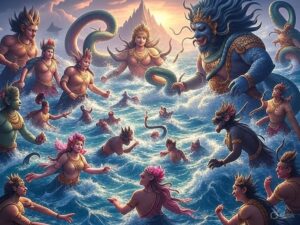
Churning of the Kosmic Ocean
What is The Dreaming Kosmos?
Imagine your consciousness as one of a billion stars in a glowing, radiant night sky, a part of one of innumerable constellations, forming patterns that guide and inspire. Like Orpheus’s lyre charting Hades, the starry sky fosters collective wisdom, harmonizing your personal goals with transpersonal illuminations from the edge of chaos. The Dreaming Kosmos envisions our waking reality as a fluid, co-created process shaped by experience, culture, and systems, akin to a dream where perceptions feel real, yet carry tangible consequences, unlike typical dreams.
What are the primal, dynamic forces that shape The Dreaming Kosmos? This chapter introduces key concepts, chaos theory, attractor basins, entropy, negentropy, emergence, holons, the entropic domain, the core identity attractor basin, polycentrism, the transpersonal, and life compass, elaborated in later chapters for their interdependent roles in fostering evolutionary awakening. Together, as Hindu myth of Samudra Manthan teaches us, they churn the kosmic ocean:
In ancient times, the gods, led by Indra, found their divine powers waning due to a curse from the sage Durvasas, who had been offended by Indra’s arrogance. The curse drained the nectar of immortality from their essence, leaving them vulnerable to their eternal rivals, the demons. Emboldened by their strength, the demons threatened to dominate the universe. To restore balance and reclaim their immortality, the gods sought the counsel of Lord Vishnu, the preserver of the cosmos.
Vishnu advised a daring plan: churn the primordial ocean to extract the nectar of immortality and other divine treasures hidden within its depths. However, the task required cooperation between the gods and demons, a rare alliance born of necessity rather than goodwill. This act of churning would represent the interplay of chaos and order, with the ocean as a chaotic matrix yielding emergent gifts.
The gods and demons gathered at the edge of the cosmic ocean, a vast, uncharted primordial void. They chose Mount Mandara as the churning rod, its peak piercing the sky and the mighty serpent king Vasuki as the rope to wrap around the mountain. The gods took Vasuki’s tail, while the gods grasped his head, pulling in opposite directions to rotate the mountain.
As the churning began, the ocean roiled with chaotic waves, disorder threatening to overwhelm the effort. The mountain began to sink into the soft ocean bed, but Vishnu, in his avatar as Kurma the tortoise, descended to support it. The tension between the rival factions, combined with Vishnu’s guidance, generated order, yielding a series of divine treasures, each a manifestation of emerging potentials from the primordial disorder.
The demons, greedy for the nectar of immortality, attempted to seize it, leading to a fierce struggle. Vishnu, foreseeing this, transformed into the enchanting Mohini, a female avatar of irresistible beauty. Mohini distracted the demons and distributed the nectar only to the gods, ensuring the restoration of divine order. Some demons, tricked into drinking poison instead, perished, while others retreated, their alliance with the gods dissolving.
The churning concluded with the gods regaining their immortality, the cosmos restored to balance, and the treasures enriching the universe. Yet, the myth suggests an ongoing cycle: the ocean’s depths remain a source of potential, to be revisited in future churnings.
Unlike Eastern traditions, such as illusory Hindu and Buddhist maya, which view life as unreal, The Dreaming Kosmos frames life as real but partial, experienced through delusions due to misperceived perspectives rooted in waking assumptions and physiological, familial, cultural, and social scripting.
Chaos Theory
Toss a pebble into a pond, and ripples spread unpredictably, influenced by tiny disturbances, such as the wind, a fish, or a dropping autumn leaf, yet forming intricate, overlapping patterns. The “butterfly effect” illustrates how minor inputs, such as a butterfly’s wings, yield large outcomes, such as a tornado, as seen in 2025 climate models where slight temperature shifts amplify weather chaos. This mirrors chaos theory’s sensitivity to initial conditions that can produce complex outcomes, like weather that is impossible to accurately predict a few days hence. Our dreams form in a realm with fewer of the neurological and cognitive restraints of waking perception, meaning that small changes can produce unexpected or creative results. They participate in a reality that is closer to the edge of chaos.
In our ocean churning myth, the primordial sea is “the edge of chaos” that we enter every night in our dreams and also in transpersonal experiences like visitations or of mystical oneness. Our entry into chaos is generally precipitated by conflicts between our gods and demons, our likes and dislikes, our strengths and weaknesses, our hopes and our resistances. However the edge of chaos itself is not a product of our conflicts nor does it care about their resolution. Rather, it is a field in which conflict, as well as time, space, and relationships, are relatively absent. The result is the creation of a space for creative reframings and the surfacing of emerging evolutionary potentials.
The problem we confront at the edge of chaos is twofold: First, we have to recognize elements at the edge of chaos for how they present and interpret themselves instead of misperceiving them by running them through our cognitive filters. We need to set aside, at least temporarily, blocking delusions. The gods and demons have to get beyond their “eternal” confrontation and cooperate in order to stabilize the world and surface its treasures. Second, we have to have some method of finding out if they are real, useful, and dependable. The gods and demons have to organize some effective means of cooperating. We need a falsifiable yoga, a disciplined structure by which we can determine the reliability and trustworthiness of emerging potentials accessed at the edge of chaos.
The gods and demons within us, personified as dream and visitation entities, as well as by our relationships with our family members and associates, are in conflict at least in part due to the partiality and self-interest biases of our perspectives, called “psychological geocentrism” in The Dreaming Kosmos. Our self-centeredness is itself a product of our lack of multi-perspectivalism, that is, our inability to empathize with the perspectives and agendas of our demons, whether interior fears, exterior abuse by others, or our life circumstances.
Attractors and Attractor Basins
In The Dreaming Kosmos, following evolutionary, systems, and chaos theory, reality is comprised of processes masquerading as stable entities, “things,” and substances, like people, rocks, snowflakes, and Jesus, in Saul’s vision on the Road to Damascus. These processes are called attractors. Attractors are stable patterns, such as rivers and cyclones, where systems settle, as Lorenz identified in 1963.
Each attractor has a basin of attraction, a set of conditions converging to that pattern. They form dynamic patterns like whirlpools that stabilize identity and experience, making it look substantial and permanent when it is actually in flux and in flow. These attractor basins have characteristics and perspectives of whole/parts, called “holons.” Sand dunes, formed by the wind’s action, are stable holons, seemingly fixed shapes, as are our habits, beliefs, and physical presence, yet in reality, impermanent, transitory processes. The wind, blowing unpredictably across a desert, sculpts patterns through its chaotic dance. This is analogous to attractors as fluid processes like our moods, memories, impulsive behaviors, and addictions. One moment they are real and demanding. In the next, when satisfied, they have evaporated into nothingness.
Orpheus’s song is like the wind as a shape-forming process, reshaping Hades’s forms, analogous to dune-like basins. The churning of the primordial sea by the gods and demons is the generation of emerging potentials in the sea of chaos, analogous to the many treasures that are uplifted by their churning. IDL character identification in interviews similarly transforms symbolic projections, our gods and demons, into autonomous potentials.
The dynamic formation of attractor basins is analogous to weather patterns, such as clouds forming from vapor. Memories, intentions, and emotions condense into identities and culture via the processes of transforming chaos into order described below as negentropy. Picture attractor basins, yourself included, as swirling whirlpools in a shimmering river, each whirlpool pulling in unique emotions, memories, intentions, and beliefs in the form of colors and shapes. Picture your habits as smaller whirlpools within the river attractor basin, pulling you into familiar patterns, smaller whirlpools that feed into cultural norms, which are larger whirlpools. In our Hindu analogy, Samudra Manthan, Mount Mandara and Vasuki serve as examples of stabilizing attractor basins. Rigid basins mirror delusion borne of partiality of perspective, while flexible ones at the edge of chaos foster creativity and evolutionary shifts, like moving from stress to resilience in dreams, just like the gods and demons churning the primordial ocean.
In dreams and altered states attractor basins in the form of dream characters or visions of angels, demons, tunnels, and light, provide flexibility due to the suspension of the structures of time and space, allowing transitions to new basins, such as from fear to hope, doubt to belief, stress to resilience, or from reactivity to equilibrium. The fundamentals of evolution, selfless organization, adaptation, and energy utilization can be enhanced. The Dreaming Kosmos counters static delusions by promoting adaptability.
Fractal Patterns
Despite their unpredictability, attractors exhibit fractal patterns, self-similar structures across scales, revealing order. A tree’s branches mirror its roots and trunk, repeating patterns from trunk to twig. This is a fractal: order across scales, like waking hopes and fears being surfaced and explained by recounting the myth of the churning of the primordial ocean or Orpheus’ journey to Hades and his ultimate demise.
Fractal patterning is seen in the coriolis effect, whether occurring in the swirling of water in our bathtub drain or in the monstrous winds of hurricanes. Dream snakes, like small branches, reflect the whole tree of waking and cultural motifs, revealing emergent unity. Jung caught this fractal nature of reality by demonstrating the continuity between personal relationships, including respected mentors and cultural archetypes, like heroes, crones, and wizards.
The fractal nature of attractors means that they can duplicate and resonate across time and space in important ways. A shout in a canyon echoes back in layered, self-similar waves, distorting yet repeating the original sound. The chaotic echoes of dream images replicate our waking dramas at an entirely different scale. Dream characters, entities, relatives, and deities can replicate in fractal fashion in our waking lives as transformative visitations of love and power. Memories traverse sleep to “reincarnate” as repetitive dream images, or dormant skills, such as the ability to play an instrument, resurface years later, as Orpheus’s song echoes in Hades’s caverns.
Entropy
The tendency of all things toward disorder and energy dissipation, entropy drives evolution. The primordial ocean is in a state of entropy until the gods and demons stir it to life. An echo in a hall starts strong but fades into silence, dissipating energy. Ordered sound is like waking stability that disperses into disorder, like a dream narrative dissolving upon awakening, fostering balance by clearing space for new patterns.
The fading of entropy allows emergence as new echoes, as Orpheus’s song echoes fade in Hades, enabling ascent. Orpheus’ life course portrays the final ascendency of entropy, in both the abandonment of Eurydice due to his own doubts and to his own eventual demise. That traces of his legacy of harmony continue to exist among the stars as the constellation Lyra implies that echoes of earthly events remain as latent potentials within the entropic domain as part of the fundamental fabric of the universe.
Snowflakes, intricate and ordered, melt into water, losing structure. You and I grow old and die, disintegrating into nothingness, our acts while alive leaving fractal echoes across future generations in our genes, preferences, and behaviors. Due to entropy, ordered forms and identities dissipate, enabling fluid change, like cultural delusions breaking down for collective renewal. As Max Plank said, “Science advances one funeral at a time.” (Paraphrase) While cognitively, entropy is the fragmentation we see in confusion and groupthink, in a transpersonal sense it is formless oneness and potentially the doorway to non-dual interdependent emergence. Without entropy there would be no movement toward evolutionary emergence, from which we can conclude that those who view entropy as the antithesis of development are fundamentally mistaken. Without the primordial ocean there would be nothing to churn and no treasures to surface.
Negentropy
Negentropy is the organization of energy into complex, ordered systems, such as life and awareness, based on selfless organization, adaptation, and energy utilization. As a selfless organizing adaptive response to entropy, negentropy drives evolutionary emergence. In open systems like the Earth, matter as well as organisms self-organize to offload excessive energy input, generally in the form of heat. In dreams and waking life, neuronal firings, emotions, and intentions form patterns, exporting waste via dissipative processes, akin to cellular health.
Negentropy organizes chaos into structure, adaptability, and meaning. It fosters growth and evolution, organizing chaotic dream elements into coherent narratives. From a chaotic solution, a crystal forms ordered structures, as Orpheus’s chaotic grief organizes into harmonious song. It is a growing seed, building order and life. Imagine a seed sprouting into a plant, weaving light and thriving, as in Egyptian Osiris’s rebirth or the Mayan corn god. The surfacing of treasures from the churning of gods and demons is a vivid portrayal of the evolutionary power of negentropy.
In The Dreaming Kosmos, negentropy organizes chaotic dreams into meaningful waking narratives, like fear of an attacker reframed via IDL into transformative wisdom. Loose threads in chaos weave into a tapestry. Negentropy is the loom’s action, creating order from disorder, like cultural myths emerging from shared dreams, balancing individual and collective perspectives.
Evolutionary Emergence
Emergence is negentropy in action. It creates novel properties from simpler components, unpredictable from their parts alone and not reducible to their component elements. Built into the evolutionary processes of selfless organization, adaptation, and energy utilization, emergence can be explained naturalistically, without recourse to creative consciousness or teleology. A seedling sprouts from a single seed in dark soil, emerging into a towering tree that reshapes the forest, creating new niches for birds and insects. This mirrors emergence: simple components, such as genes and the environment, yield complex organisms and ecosystems through selfless organization.
Like Orpheus’s song emerging harmony from chaos, the seedling’s process of growth creates a very real and useful flora canopy, benefiting the collective forest, fostering reciprocity among species. Emergence shapes attractor basins, such as molecules, dreams, and cultures through negentropic interactions.
Complexity Jumps
Evolutionary development driven by complexity jumps are sudden leaps in system organization. Churning up treasures from within the primeval ocean of chaos is a complexity jump. You interview a hyper-active wolf you met in a dream. It is always pacing, stressed, never dropping its preparedness. The wolf says it is a personification of your constant vigilance due to childhood trauma. Now, imagine that you ask the wolf if it wants to change. It responds by saying it wants to have a safe cave where it can retreat to in order to rest, so it can regenerate and not always be vigilant.
We can think of the wolf as a visual metaphor for an attractor basin of hyper-vigilance existing within the larger attractor basin of your core identity attractor basin. What has been created metaphorically is a complexity jump in your hyper-vigilant attractor basin. Whenever you become the resting wolf in its cave you are reconfiguring your hyper-vigilant attractor basin in a realistic way. You aren’t imagining you can magically eliminate your hyper-vigilance. Instead, you are redefining it in a complexity jump to include the emerging potential of life balance. This won’t change your core identity attractor basin itself because your hyper-vigilance is only one component of it, but it will move your identity toward health and balance. You are priming concrete changes to your central nervous system, rebalancing it away from sympathetic activation toward parasympathetic relaxation and balance. This is an example of how IDL dream yoga supports evolutionary emergence by generating complexity jumps through accessing emerging potentials.
Complexity jumps are rare due to the gravitational” pull of highly adaptive entrenched attractor basins we call habits, that can exert great, overpowering inertia. It is not unusual for people to have breakthroughs in therapy, believe that they have escaped their past, only to find both dreams and waking life pulling them back into old feelings and habits. This can be very discouraging. However, understanding how and why this happens is a first important step toward compensating for it.
Theta Waves
Prominent in both dreaming and meditation, Theta waves (4–8 Hz), correlate with integrative processes and altered states. The ocean’s tides ebb and flow in a steady, hypnotic rhythm, connecting shore, analogous to connecting your waking self to the vast sea of your dreaming and deep sleep self. This mirrors Theta waves: a gentle oscillation facilitating dreaming and transpersonal access at the edge of chaos, balancing waking and altered states. Like Orpheus’s lyre producing vibrations harmonizing Hades, Theta’s rhythm bridges waking delusions and dream emerging potentials, fostering creativity and beneficial reframings through shared resonance. Training Theta balances alertness and relaxation, supporting life balance and access to emerging potentials. Theta is elevated during psi, implying increased access to the edge of chaos and to the entropic domain.
Holons
A term coined by Arthur Kostler in The Ghost in the Machine, 1967, holon (a part/whole), was adopted by Ken Wilber to refer to the four quadrants of reality that we introduced in the first chapter: “I” (subjective), “It” (behavioral), “We” (cultural), “Its” (systemic). Attractor basins emerge from interactions across those four quadrants. As an example, coral polyps are individual organisms (wholes) forming reefs, themselves parts of a greater whole, an ecosystem, each sustaining and sustained by the collective. In the churning of the primeval ocean, each treasure is a whole within the cosmic whole. Like Orpheus’s lyre uniting Hades’s shades, polyps (holons) balance individual survival with collective reef harmony, fostering reciprocity. This reflects holons: individuals or dream images contributing to larger systems.
The Four Quadrants of Holons
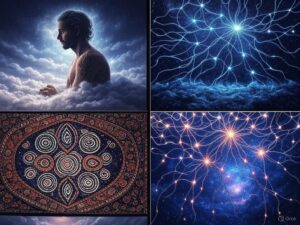
Attractor basins present processes as stable “things” like souls or objects. Language and our need to objectify experience fuel this delusion borne of partiality, separating us from life, balance, and transformation. Holons are the personal and collective interiors and exteriors of all things as well as the particular balance of subjectivity and objectivity that exists in every life experience. They anchor The Dreaming Kosmos in multi-perspectival development, honoring diverse cultures and systems. Attractors, as naturalistic processes with holonic perspectives, generate identity, narratives, and potentially non-local experiences, like dreams. This model is testable via Theta neuroscience, negentropic emergence, and IDL practice.
Polycentrism
A central organizational principle of The Dreaming Kosmos, polycentrism is both a worldview and a practice of embracing multiple perspectives, such as maps or models of reality, or of becoming perspectives that are “other,” through a process of identification with dream characters, life issues of central importance to you, or transpersonal elements. Polycentrism reflects cosmology, recognizing that in the universe there is no center but rather that every point is the center. A kaleidoscope mirrors polycentrism. As it rotates it blends multiple colored shards into diverse, harmonious patterns, each view valid yet part of a unified whole. In the Hindu churning myth, Samudra Manthan, the cooperation among rivals reflects polycentrism.
When we interview the “other,” whether it is a dream antagonist or the personification of life issue, such as a fear of rejection, or a national enemy, we are creating a cooperative and respectful relationship where alienation, ignorance, and defensiveness previously existed. Dream characters, personifications of life issues, aspects of transpersonal experiences, and cultural motifs and events are all integrated into a cohesive yet pluralistic understanding. Like Orpheus’s lyre harmonizing Hades’s shades, the kaleidoscope’s shifting perspectives balance individual viewpoints for collective wisdom, fostering empathy through relational unity.
Empathetic Multi-perspectivalism
Polycentrism is another word for multi-perspectivalism, the ability to constructively dissociate and see the world from multiple, non-self-centered, positions. There are two varieties of polycentrism. Valuing multiple perspectives fosters cognitive multi-perspectivalism. It is analogous to map reading, which allows you to survey and navigate a territory. Actually becoming multiple perspectives and viewing experience from their worldview, not ours, develops empathetic multi-perspectivalism. It is analogous to becoming the features on the map, roads, buildings, fellow travelers, animals, pastures, mountains, rivers, and viewing the territory from their perspectives. The distinction is between understanding and transformation.
This variety of empathy is much more profound than “normal” empathy, which is to assume we know what another person is feeling and acknowledging it. The descent of a muse, whose perspective possesses the recipient, is a classical example of fully embodying an alternative perspective. In Oedipus Rex, Tiresias, the blind seer, embodies male and female perspectives, seeing truths others miss.
Empathetic multi-perspectivalism requires validation, that is, the other party must confirm that we hear them. This confirmation is fundamental to both multi-perspectivalism and listening in a deep and integral way. In IDL, that is done through the answers given by interviewed perspectives to questions in the interviewing protocols and character validation of our daily application of their recommendations. The ability to empathize at this depth is a skill that must be developed, and there are several good reasons why it does not come naturally, which will be explained below.
Tetra-Mesh
Tetra-mesh is the dynamic interplay of AQAL’s quadrants and eight zones, such as phenomenology and empiricism, weaving self, others, facts, and systems like Indra’s Net. An ecosystem interweaves individual organisms (I), species interactions (We), physical resources (It), and environmental systems (Its), forming a balanced whole. This reflects the tetra-mesh: quadrants co-evolve dynamically.
As a form of polycentrism, tetra-mesh fosters balance and higher-order integration, approximating attractor basins with limited ingredients, akin to weather’s deterministic chaos. Tetra-mesh can also be thought of as a “recipe,” or combination of “ingredients” that produce a particular attractor basin. The ingredients are not of an equivalent amount and they are relatively few, just as only a few ingredients, moisture, temperature, mass, and gravity combine to produce the chaotic attractor of weather.
In the worldview of The Dreaming Kosmos, some degree of tetra-mesh is required to establish the balance necessary to maintain some higher level of advancement. Because mystical experiences rarely tetra-mesh with our waking lives, they usually fade away, just as does normal dream recall. IDL attempts to develop tools and strategies to support tetra-mesh so that transformation is authentic and lasts.
Entropic domain
The entropic domain is a hypothetical overarching informational network unifying physical, self, dream, and cultural basins, integrating memories, emotions, and intentions for healing and transformation. An analogy is multiple rivers from different regions converging into a single, stable delta, blending unique cultures as diverse waters into a shared ecosystem while retaining distinct currents. This mirrors an entropic domain: diverse cultural perspectives, such as values and myths, stabilize into a cohesive pattern through empathetic integration.
The myths that are used throughout The Dreaming Kosmos to illustrate its concepts, together create a tapestry that transcends any one culture, generating an entropic level of awareness and understanding. Like all attractors, the entropic domain has objective and subjective faces. The latent subjective face is hypothesized to be the ground that allows for telepathy, precognition, and access to lost knowledge. The objective face is emergent and reflects human transpersonal potentials.
Psychological Geocentrism and Heliocentrism
Our normal waking perspective is generally referred to as “ego-based,” or “self-centered.” The Dreaming Kosmos does not use either of these terms because they imply either selfishness or the dynamic psychology of Freud and Jung. Instead, it uses “psychological geocentrism,” to indicate reality that orbits around our own self-definition, like the sun, planets, and stars orbiting the Earth. This is analogous to a garden walled off from the world, where the owner tends only familiar plants. Ignoring outside diversity mirrors geocentrism’s self-focused security, providing balance through control but hindering collective good by excluding others’ perspectives. Myths like Eden’s expulsion highlight how such isolation leads to stagnation and alienation.
Psychological heliocentrism refers to a worldview in which self is transcended by a Self that is one with all, analogous to the sun being the source of all light and life. The Self as a radiant center illuminates all but remains the pivot. Sunflowers turn toward the sun, drawing life from it but fixed in their orientation. Psychological heliocentrism provides balance through unity but limits collective good by assuming, since it is one with truth and goodness and one with all, that it knows what is true, good, and right for others. This is grandiosity disguised as enlightenment. Like the gods and demons cooperating at churning the primeval ocean to surface treasures, polycentrism balances both, in congruence with the Einsteinian shift toward multi-perspectival clarity. Like a diverse ecosystem, polycentrism allows multiple centers for reciprocity and interdependent co-origination.
Core Identity Attractor Basin
This term refers to identity primarily as process rather than substance. “Thingness,” or holonic characteristics and perspectives, are attributes of processes. The goal is not enlightenment or “self-actualization,” but lucidity, waking out of the delusions generated by partial perceptions of reality into an awareness of life’s dreamlike nature. Beyond that is the balancing of objectivity, as lucidity, and subjectivity, as profound receptivity. IDL fosters both objectivity and balance, like Ra’s rebirth or IDL pranayama’s dawn-like awakening. A river’s flow carves a stable yet evolving riverbed, shaped by water as experience, rocks as beliefs, and river banks as relationships, forming a unique path. This mirrors the core identity attractor basin, in which personal experiences and relationships stabilize into a dynamic self-pattern, adaptive yet stable.
The Transpersonal
The term “transpersonal” originates in psychology and philosophy, referring to experiences, states, or perspectives that transcend psychological geocentrism and personal boundaries, often involving interconnectedness with others, nature, or the cosmos, meaning the four states of oneness outlined in Chapter 1. Coined in the mid-20th century by Roberto Assagioli and popularized by Abraham Maslow as the “fourth force” in psychology, beyond psychodynamic psychology, behaviorism, and humanism, the transpersonal encompasses spiritual, mystical, and collective dimensions of consciousness. Definitions vary by thinker, ranging from developmental stages to non-ordinary states. Here are five representative definitions of the transpersonal followed by the perspective of The Dreaming Kosmos.
Transpersonal as Self-Transcendence
Abraham Maslow (1968) viewed the transpersonal as a realm of “peak experiences” and self-actualization beyond ego needs, where individuals transcend personal concerns to connect with universal values like beauty, truth, and unity. It involves “being-values” (B-values) like altruism and wholeness, emerging after self-actualization. In the Hindu Bhagavad Gita, Arjuna transcends his ego-driven doubts on the battlefield, guided by Krishna to see the cosmic form (Vishvarupa), revealing unity beyond personal roles. Arjuna’s vision of the infinite dissolves his fear, embodying self-transcendence. Like a drop of water merging into the ocean, we lose our individuality to become part of the vast whole, retaining our essence but gaining universal flow.
Transpersonal as Developmental Stages Beyond the Personal
Ken Wilber’s Integral Theory (1980), frames the transpersonal as post-conventional stages of consciousness, such as “integral” or “non-dual”, where identity expands from egoic self to worldcentric collective and cosmic awareness, integrating personal, cultural, and spiritual dimensions across quadrants. In the Norse myth of Yggdrasil, Odin sacrifices an eye for wisdom, ascending from personal heroism to cosmic interconnectedness, linking nine worlds in a transpersonal tree of life. Odin’s journey reflects stages of expansion beyond self. In this formulation, we are like a tree’s roots delving deep while branches reach skyward, growing from individual grounding to collective canopy, each level building on the last for holistic integration.
Transpersonal as Non-Ordinary States of Consciousness (Grof,)
Stanislav Grof, a founder of transpersonal psychology, defines it as access to non-ordinary states, such as via psychedelics and breathwork, revealing archetypal, perinatal, or transpersonal realms like past lives or unity with the universe, transcending ego boundaries for healing and illumination (1975). In the Egyptian myth of Osiris’s dismemberment and resurrection, Isis reassembles his body and revives him through altered states, accessing transpersonal realms of death and rebirth for cosmic renewal. Osiris’s fragmented self integrates into eternal kingship. Like a shattered mirror reflecting infinite selves, each fragment revealing a larger whole, we disassemble ego to reassemble universal awareness.
Transpersonal as Collective Unconscious and Archetypes
Carl Jung (1933), described the transpersonal as the collective unconscious, a shared psychic reservoir of archetypes, such as hero and shadow, transcending personal experience, accessed through dreams or synchronicity for individuation and cultural integration. In the Greek myth of the Argonauts’ quest, Jason confronts archetypal trials, such as the Clashing Rocks, drawing on the collective unconscious for heroic integration. The journey unites personal and mythic realms. Like rivers converging into a vast ocean, individual streams of personal psyches merge into archetypal depths, each current unique yet part of the universal flow.
Transpersonal as Non-Dual Awareness
In Advaita Vedanta, transpersonal is non-dual realization, Advaita, where the individual self, Atman merges with universal consciousness Brahman, transcending ego, duality, and illusion maya for liberation moksha. In the Hindu myth of Shiva’s cosmic dance, Shiva dissolves and recreates the universe in non-dual unity, embodying Atman-Brahman oneness. The dance transcends creation/destruction duality. Like a wave recognizing itself as the ocean, arising and dissolving without separation, transpersonal awareness dissolves the self into boundless consciousness.
In The Dreaming Kosmos, the transpersonal aligns with polycentric emergence, where states of oneness access latent potentials for collective harmony. From this perspective, access to the transpersonal is latent and ever present, as seen in animal and autistic children telepathy, and also an emerging potential of humanity.
Life Compass
When multiple perspectives are interviewed by IDL, recurring patterns and themes are elaborated. These shared interests point us toward underlying, organic priorities of core processes which The Dreaming Kosmos and IDL call “Life Compass.” It evolves as you do, guiding you on like the North Star. Conceptualized as one facet of the entropic domain, life compass is itself an attractor basin that aligns your waking goals with holonic evolution.
Five Fundamental Principles
Process contextualizes substance. The churning of the ocean by the gods and demons is a dynamic process, not a static event, yielding emergent treasures from chaos. Holons are emergent properties, characteristics, and perspectives of processes. They can be conceptualized as the stable and “frozen” basins of processes whose chief function is the maintenance of life stability. However, some basins are more transformational than others. Dream and altered state attractor basins are relatively “fluid,” functioning at the edge of chaos. While attractor basins tend to emphasize stability in biological, self, dream, and cultural domains, the attractors themselves tend toward the edge of chaos, because they are relatively undefined and unlimited. A rule of thumb is that where holonic aspects of attractors predominate, circumstances favor evolutionary adaptability. Where attractors themselves predominate, circumstances favor evolutionary transformation, because attractors themselves are by nature relatively unconditioned.
Dreaming contextualizes waking. Just as process contextualizes substance, the creativity and descent into probabilities from actualities in dreaming supercharges evolution. It shifts life priorities from psychological geocentrism to polycentrism and empathetic multi-perspectivalism, from survival and cultural fit to cooperation and intrasocial fit.
Balance contextualizes development. The Dreaming Kosmos prioritizes balance over development, as stability enables dialectical growth. Theta’s efficiency and Yin-Yang harmony counter entropic fragmentation, aligning with non-Western perspectives like Taoist wu wei and Buddhist anatta. The cooperation between Devas and Asuras, balanced by Vishnu’s intervention, prioritizes harmony over linear progress. Prioritizing development leads to line imbalances that tend to collapse the entire developmental enterprise sooner or later, on both individual and collective levels. Typically, lines of cognition and professional competencies race ahead of moral development. This is generally hidden or unrecognized until stressed or challenged. In replicated studies in the 1960’s, Stanley Milgram showed that some two-thirds of experimental subjects would shock someone to death when told to by an experimenter.
For healing and transformation to last, emphasis needs to be placed on securing a stable and broad foundation, one that has to get broader the higher you want to climb. Emphasizing balance shifts framing from “higher and lower” and “raising your vibration” to adaptive adequacy, much more in line with evolutionary theory. An emphasis on balance is also in alignment with dialectical theory, in which thesis must be established before synthesis can be maintained, as well as with basic principles of Taoism, as we shall see.
An emphasis on balance as a priority complements developmental and spiritual models, like Integral AQAL, that view “higher” states and “faster” vibration as better than “lower” stages of development and “slower” rates of vibration. Similarly, because a secure foundation is a pre-requisite for stable dialectical development, The Dreaming Kosmos emphasizes adaptation over growth and transformation. We can see this prioritization throughout the natural world in the proliferation of generated potentials representing possible futures, with almost all of this energy and potential sacrificed for maintenance of species survival. When balance is prioritized, focus shifts from who you want to become or comparing your level of development to others to the maximization of who, where, and what you are now. This is in alignment with fundamental transpersonal principles. When you focus on attaining and maintaining balance, tetra-mesh, emergence, and attractor basins functioning at the edge of chaos, like those in dreams and transpersonal experiences, you move toward higher order integration, supported by transpersonal openings, countering entropic fragmentation.
Collective goods contextualize individual benefits and needs. The surfaced treasures in our Hindu creation myth benefit all creation, reflecting polycentrism and collective wisdom. Evolution occurs due to species-wide, collective alterations, and individual survival can be and are subordinated to that end. This is an evolutionary adaptational principle that has largely been ignored by those emphasizing individual freedom, rights, and prosperity. From the Forward:
Our words generate our reality.
Our thoughts generate our reality.
Our communication generates our reality.
The Dreaming Kosmos attempts to ground our words, thoughts, and communication about reality in a common language of naturalism. To do so in 2026 is to introduce some unnatural concepts, because most of us are not used to thinking about reality in naturalistic terms. However, to the extent that reality is indeed collective, an experience that can be communicated and shared, it is naturalistic, that is, based on collective or shared conclusions about the nature of reality. That does not mean that individual experiences and conclusions are not equally valid on a personal level – it just means that validation on a collective level gives them validity they otherwise lack.
The conclusion then is not that the exterior objective quadrants are superior to the interior subjective ones, but only that they contextualize them, because all individuals are members of collectives.
Justice contextualizes personal intent. It is common for us to justify our actions based on our intentions. Our argument is basically, “Because my intentions were honorable and serve a greater good, my actions are justified.” That greater good may be national, religious, or spiritual. It doesn’t matter. The argument is the same.
While in some cases human collectives, whether formal, like courts, or informal, as in public opinion, will accept such arguments, when justifications based on intent excuse actions that threaten fundamental interests of collectives, intent is overruled. Justice contextualizes personal intent in general, but acceptance of minor infractions leads individuals and groups, including corporations and governments, to believe that intent supersedes justice. This can end up being a fatal miscalculation.
Justice does not exist in pre-human evolution. Like it or not, physical laws like gravity and forces like sunlight are amoral and care not at all about human existence. Humans can either adapt to an amoral natural order and move into flow with it or not, and then experience naturalistic consequences. Nature says, in effect, “Nothing personal, but you are going to die.”
Similarly, social laws, representing justice, exist for pragmatic, utilitarian purposes to serve collectives, often to the detriment of individuals. As a consequence, justice contextualizes personal intent and individual goods. Justice is an evolutionary emergent necessitated by the complexity of human relationships. Ethical integrity both supports justice and determines what is experienced as just or unjust. In human relationships, ethical integrity manifests as core qualities that appear to drive evolutionary unfolding, including respect, trustworthiness, empathy, and reciprocity. Both physical and social laws cannot be ignored without diminishing human evolutionary emergence, just as Darwin could not ignore the fundamental nature of cooperation for the emergence of species.,
Research Possibilities
Claim: Life is real but partial, experienced through delusions due to misperceived perspectives from waking assumptions and scripting.
This posits that delusions arise from biased (geocentric) views, reducible via multi-perspectival practices like IDL. Experimental design could involve a randomized controlled trial (RCT) with 100 participants (adults, no history of psychosis). Divide into groups: (A) IDL intervention, such as dream character interviews to adopt “other” perspectives), (B) control (neutral journaling). Measure baseline and post-intervention “delusion” via validated scales like the Peters Delusions Inventory (PDI) or cognitive bias tasks, such as confirmation bias tests.
The procedure could involve an 8-week program; pre/post fMRI scans during perspective-taking tasks to assess brain activity in empathy regions, such as temporoparietal junction. If Group A shows reduced PDI scores and increased neural flexibility, claim supported. Falsification: No difference or worsening in Group A.
Claim: Dreams operate closer to the “edge of chaos” (per chaos theory), where small changes yield creative results due to fewer neurological restraints.
This claim draws on the butterfly effect; dreams as sensitive to initial conditions, fostering creativity. Design would include a sleep lab study with 50 participants. Use polysomnography (PSG) to monitor REM sleep (dreaming). Introduce “small perturbations” pre-sleep, such as mild sensory stimuli like scents or sounds vs. control (no stimuli). Participants report dreams upon waking; analyze for complexity, such as narrative unpredictability via entropy metrics in text analysis. Use chaos math, such as Lyapunov exponents) on dream report variability. Higher complexity/creativity (rated by blind judges) in perturbed group supports claim. Falsification: No increase or reduced complexity.
Claim: Conflicts (gods/demons) precipitate entry into chaos, but the edge of chaos is neutral, enabling creative reframings and evolutionary potentials.
The theory is that entropy is an emergent relational pattern without time/space/relationships, accessed via dreams/transpersonal states. Longitudinal study with 80 participants experiencing conflict, such as stress from relationships could be undertaken. Half undergo IDL to “interview” internalized conflicts; half get standard CBT. Track pre/post “reframing” via journals and scales, such as Cognitive Flexibility Inventory. Measure evolutionary potentials, such as self-reported growth in resilience, over 6 months. Validation IDL group shows more novel reframings, such as thematic analysis of journals. Falsification: No difference or CBT superior.
Claim: Reality consists of processes (attractors) masquerading as stable entities, with basins forming dynamic patterns like habits or identities.
• Rationale: Attractors, such as rivers, moods) are flux; testable via systems theory.
• Experiment Outline:
• Design: Computational modeling + human study. Simulate attractor basins using dynamical systems equations, such as Lorenz attractor) on 40 participants’ habit data.
• Procedure: Track daily habits, such as via app) for 3 months; perturb with interventions, such as mindfulness to shift basins. Analyze stability via phase space plots.
• Validation: Perturbations lead to predictable shifts in habit patterns, such as from stress to resilience. Falsification: Patterns remain static despite interventions.
• Feasibility: Use code execution tool for simulations, such as Python with numpy/scipy for attractor modeling.
Claim: Attractors exhibit fractal patterns (self-similarity across scales), seen in dreams mirroring waking/cultural motifs.
• Rationale: Fractals in nature, such as trees, extend to psychology, such as dream snakes as motifs).
• Experiment Outline:
• Design: Content analysis study with 60 dream journals from diverse cultures.
• Procedure: Quantify fractal dimensions, such as box-counting method) in dream narratives vs. waking life stories. Correlate with cultural archetypes, such as Jungian analysis.
• Validation: High self-similarity scores between dream/waking scales support claim. Falsification: No fractal patterns or cultural mismatch.
• Feasibility: Code execution for fractal analysis; cross-cultural recruitment via online surveys.
Claim: Entropy drives evolution by dissipating order, clearing space for new patterns; negentropy organizes chaos into structure.
• Rationale: Entropy as fading, such as dream dissolution; negentropy as emergence, such as crystal formation.
• Experiment Outline:
• Design: Neuroimaging study with 50 meditators/dreamers. Induce entropic states, such as sensory deprivation vs. negentropic, such as IDL structuring dreams.
• Procedure: Measure brain entropy, such as via EEG sample entropy and post-session creativity/emergence, such as divergent thinking tests.
• Validation: Entropy conditions lead to disorder then novel ideas; negentropy to ordered growth. Falsification: No correlation or reverse effects.
• Feasibility: EEG labs; code for entropy calculations.
Claim: Evolutionary emergence creates novel properties via selfless organization; complexity jumps via IDL reconfigure attractor basins.
• Rationale: Example: Hyper-vigilant wolf dream reframed to balance.
• Experiment Outline:
• Design: Pre/post intervention RCT with 70 trauma survivors. IDL group interviews dream elements; control uses narrative exposure therapy.
• Procedure: Measure CNS balance, such as HRV for sympathetic/parasympathetic and complexity, such as psychological flexibility scales over 12 weeks.
• Validation: IDL shows “jumps” in HRV balance and reduced vigilance. Falsification: No jumps or regression to habits.
• Feasibility: Trauma clinics; longitudinal tracking apps.
Claim: Theta waves (4–8 Hz) facilitate access to edge of chaos, creativity, and transpersonal states.
• Rationale: Elevated in dreams/meditation/psi; bridges waking/delusions.
• Experiment Outline:
• Design: EEG study with 40 participants. Train Theta via biofeedback vs. sham.
• Procedure: Test pre/post for creativity, such as Torrance Tests and transpersonal access, such as self-reported oneness scales during meditation.
• Validation: Increased Theta correlates with higher creativity/oneness. Falsification: No change or Beta waves dominate.
• Feasibility: Neurofeedback devices; existing psi protocols.
Claim: Holons (part/wholes) as quadrants (I/We/It/Its) generate attractor basins; tetra-mesh weaves them for integration.
• Rationale: Based on Wilber/Koestler; testable via multi-perspectival balance.
• Experiment Outline:
• Design: Group dynamics study with 60 participants in teams. Apply tetra-mesh training, such as quadrant-based decision-making vs. standard.
• Procedure: Measure integration, such as team performance, empathy scales over simulated tasks.
• Validation: Tetra-mesh groups show higher-order outcomes, such as innovative solutions. Falsification: Fragmentation or no improvement.
• Feasibility: Organizational psych labs; code for quadrant modeling.
Claim: Polycentrism (empathetic multi-perspectivalism) reduces geocentrism, fostering empathy and transformation.
• Rationale: IDL interviews confirm “other” perspectives; vs. cognitive multi-perspectivalism.
• Experiment Outline:
• Design: Empathy training RCT with 80 participants. Empathetic (IDL embodiment) vs. cognitive (perspective discussion) vs. control.
• Procedure: Pre/post empathy measures, such as IRI scale, behavioral tasks and validation, such as interviewed perspectives’ confirmation.
• Validation: Empathetic group shows deeper empathy gains. Falsification: Cognitive superior or no validation.
• Feasibility: Online IDL platforms; actor simulations for validation.
Claim: Entropic domain unifies basins for healing; latent for telepathy/precog.
• Rationale: Hypothetical network; testable via shared experiences.
• Experiment Outline:
• Design: Parapsychology study with 50 pairs (cross-cultural). One experiences event; other reports via IDL-like recall.
• Procedure: Measure hits via blind matching; correlate with Theta/entropy.
• Validation: Above-chance shared info supports. Falsification: Chance-level or cultural bias.
• Feasibility: Ganzfeld protocols; ethical psi guidelines.
Claim: Four principles (process > substance, balance > development, collective > individual, justice > intent) guide evolution.
• Rationale: Prioritizes balance/collective; testable in social/evolutionary contexts.
• Experiment Outline:
• Design: Simulation + human study. Model evolutionary scenarios, such as agent-based) emphasizing principles vs. opposites.
• Procedure: In humans, ethical dilemmas, such as trolley problems with groups prioritizing principles; measure outcomes, such as group stability.
• Validation: Principle-based leads to adaptive emergence. Falsification: Development/individual superior.
• Feasibility: Code execution for simulations, such as NetLogo-likeƒ; social psych
Practical Applications: Continue developing your transpersonal dream yoga
The Dreaming Kosmos is rooted in four testable mechanisms: 1) the neuroscience of Theta waves, supporting the analogy of life as dreamlike, 2) the negentropic processes of evolutionary emergence, and 3) your own life practice of a transpersonal, phenomenalistic dream yoga, by which you can test the model, and 4) the falsifiability of its assumptions, encouraging research to generate peer-reviewed assessments of its credibility. However, credibility and validity are finally determined by what makes sense to you and what proves useful in your life for promoting your healing, balancing, and transformation.
To this end, begin to experiment with IDL dream yoga in your life. Begin by interviewing a dream character of your choice using the Dream Interviewing Protocol in Appendix H. Choose at least one recommendation to apply and track in your daily life in order to test the trustworthiness of the recommendation and the methodology.
Set intent: Before going to sleep, resolve to be vigilant and remember a dream or two, writing it down upon awakening.