
From Enactment to Listening: Integral Deep Listening in Dialogue with Moreno’s Psychodrama
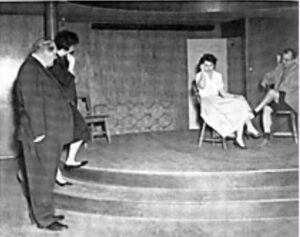
In his invention of psychodrama, Jacob Levy Moreno remembered something modern psychology had forgotten: that healing requires participation. Against the prevailing medical model of observation and interpretation, Moreno placed human beings on their feet, in relationship, in motion. He understood that spontaneity is not a luxury but a biological and social necessity, and that pathology emerges where spontaneity collapses.
Integral Deep Listening (IDL) stands in this lineage. It would not exist without psychodrama. And yet, it arrives at the same threshold from the opposite direction. Where Moreno emphasized action, IDL emphasizes listening; where psychodrama amplifies expression, IDL minimizes intervention; where Moreno trusted catharsis, IDL trusts reorganization.
This is not a disagreement so much as a difference of emphasis, a shift from doing to allowing, from staging to sensing, from mobilization to emergence.
The Shared Ground: Multiplicity, Roles, and the Social Nature of the Psyche
Moreno’s most enduring contribution was his recognition that the psyche is inherently plural. We do not have roles; we are roles, enacted within relational fields. Psychodrama operationalized this insight by giving roles bodies, voices, and space.
IDL shares this foundational assumption. It begins from the same premise: that identity is not unitary, that inner life is composed of perspectives, and that suffering arises when these perspectives are excluded, frozen, or silenced. In both approaches, healing does not come from interpretation, but from participation. The system must experience itself differently. Where they diverge is in how much structure and stimulation is required for that experience to reorganize.
Action Versus Suspension
Psychodrama is built on action. The stage is literal. Roles are embodied. Auxiliary egos intervene. The director structures scenes, escalates emotion, and guides the arc toward insight or catharsis. This activation is not incidental; it is the engine of change.
IDL moves in the opposite direction. It reduces action to the minimum necessary for perspective to speak. There is no stage, no reenactment, no doubling, no corrective experience orchestrated from outside. The dreamer or client remains seated, awake, and cognitively oriented. What changes is not behavior, but identification.
This distinction is particularly salient in trauma work. Psychodrama can be profoundly reparative when containment is strong and the nervous system can tolerate activation. IDL is designed for conditions where activation itself may destabilize. In IDL, nothing is reenacted. Nothing is relived. The system is not asked to prove its resilience. It is asked to be heard.
Spontaneity and the Edge of Chaos
Moreno defined spontaneity as the capacity to respond adequately to a new situation or newly to an old one. Psychodrama was his method for restoring this capacity through creative action.
IDL shares the goal but locates spontaneity elsewhere. Rather than mobilizing spontaneity through expression, IDL uncovers it by removing constraints. When identity loosens, when no perspective is privileged or suppressed, spontaneous reorganization becomes possible. This is spontaneity without performance.
From a systems perspective, psychodrama perturbs the system from the outside, introducing novelty through enactment. IDL perturbs the system from within, by suspending the usual rules of identity and interpretation. Both operate at the edge of chaos; they simply arrive there by different routes.
Catharsis and Its Alternatives
Moreno trusted catharsis. He believed emotional discharge restored flow where affect had been dammed. For many clients, this remains true.
IDL neither seeks nor avoids catharsis. It treats strong emotion as one possible perspective among many, not as a privileged agent of change. When emotion arises, it is listened to, not amplified nor resolved. This is not emotional bypass. It is emotional decentering.
Clinically, this matters because some traumatized systems cannot metabolize catharsis without retraumatization. IDL offers a pathway in which affect reorganizes itself through inclusion rather than discharge.
Authority and the Director
Psychodrama requires a director. Even at its most egalitarian, someone structures the field, decides when to intervene, and holds the arc of the work. This authority can be containing, reparative, and deeply relational. IDL deliberately minimizes this role. The facilitator does not interpret, guide insight, or shape outcome. Questions are neutral. The system decides what speaks next. Authority is diffused rather than centralized.
This difference reflects divergent ethical stances. Psychodrama assumes that skilled direction enhances safety and depth. IDL assumes that removing directional pressure is what allows self-organization to occur. Neither is universally superior. Each is context-dependent.
The Role of the Group
Moreno believed in the group as healer. Psychodrama leverages collective witnessing, resonance, and shared affect to accelerate change. IDL is fundamentally dyadic or intrapsychic. While it can be practiced in groups, its core mechanism does not rely on group amplification. The “group” in IDL is the internal ecology of perspectives itself, called by IDL ones’ “Intrasocial Sangha.” In this sense, IDL internalizes psychodrama’s social insight. The stage becomes the psyche. The audience becomes awareness. The roles speak for themselves.
Roles and Perspectives
A subtle but clinically consequential distinction between psychodrama and Integral Deep Listening lies in the difference between roles and perspectives. In Moreno’s framework, roles are the basic units of personality and relationship. A role is a perspective that a self identifies with or becomes: parent, teacher, worker, child; persecutor, victim, rescuer; hero, witness, antagonist; actor on a stage or screen. Even when roles are reversed or newly enacted, they remain organized around an implicit center—a self that has or inhabits roles. Psychodrama expands spontaneity by multiplying and flexibilizing these identifications, allowing the self to move more freely among them. This is a profound advance over rigid ego models, but it nonetheless preserves the underlying structure of identity as a role-organizing hub.
IDL departs at this point. In IDL, what is interviewed or embodied is not a role in the representational sense—something that stands in for, expresses, or defends a more fundamental self—but a relatively autonomous perspective that does not refer back to a core identity attractor at all. A dream figure, emotion, sensation, image, or even an absence is approached not as my anger, my child-self, or my protector, but as itself. It does not represent something else more basic; it speaks from its own position within a distributed system. Because such perspectives are not tethered to the biological imperatives, family loyalties, cultural scripts, or social expectations that shape role identity, embodying them temporarily suspends the adaptive stability of the self rather than expressing it. The result is a qualitatively different freedom: not the freedom to enact new roles more flexibly, but the freedom of selfless organization, in which reintegration occurs without reference to preserving, amplifying, or concealing an existing identity structure. Roles may soften the self; perspectives, as engaged in IDL, can unfreeze it.
Two Paths to the Same Threshold
Psychodrama and IDL are complementary responses to the same clinical truth: that systems change when participation replaces observation.
Psychodrama says: Enter the role. Move. Speak. Act.
IDL says: Become the emerging perspective. Listen. Stay. Allow.
Both trust that something wiser than the therapist is at work. Moreno opened the door by insisting that psychology must be lived. IDL steps through that door and sits down, trusting that when the system is no longer coerced, by interpretation, by reenactment, by outcome, the next organization will emerge on its own. At the edge of chaos, action and listening meet. Moreno taught us to move there. IDL teaches us to wait, and to hear what has been speaking all along.