
The Five Trees and Meditation

Transcending Your Monkey Mind:
The Five Trees and Meditation
(From Integral Deep Listening and Meditation)
Introduction
This short text will not tell you when or how often to meditate. It will not tell you how to sit, whether to have your eyes open or closed, whether you need a quiet space, whether to use your breath, the wall, a flame, a picture, or an inner image or color as a centering tool. It will not tell you whether you should have animals around you or what you should do to prepare for meditation. It doesn’t make recommendations that you purify yourself by abstaining from this or that sort of thought, feeling, or action. It doesn’t require that you believe in anything or anyone or have any previous knowledge of meditation. If it doesn’t offer you any of these things, what does it have to offer?
To reverse a metaphor, it’s easy to focus on the forest and not see the trees of meditation. In this case, there are five of them. Together, they constitute the entirety not only of your experience, but your identity. When you understand your relationship with them, you will understand how your mind works when you meditate. With this knowledge you can transcend both mind and self without needing to subscribe to any particular approach to meditation, or you can successfully work with just about any approach. Without this knowledge you can practice any one of countless approaches to meditation and still have limited success.
The concepts here are simple. There is nothing that you cannot and should not test for yourself. As the Buddha said,
Believe nothing just because a so-called wise person said it.
Believe nothing just because a belief is generally held.
Believe nothing just because it is said in ancient books.
Believe nothing just because it is said to be of divine origin.
Believe nothing just because someone else believes it.
Believe only what you yourself test and judge to be true.
Your Mind Monkeys Inhabit Five Trees
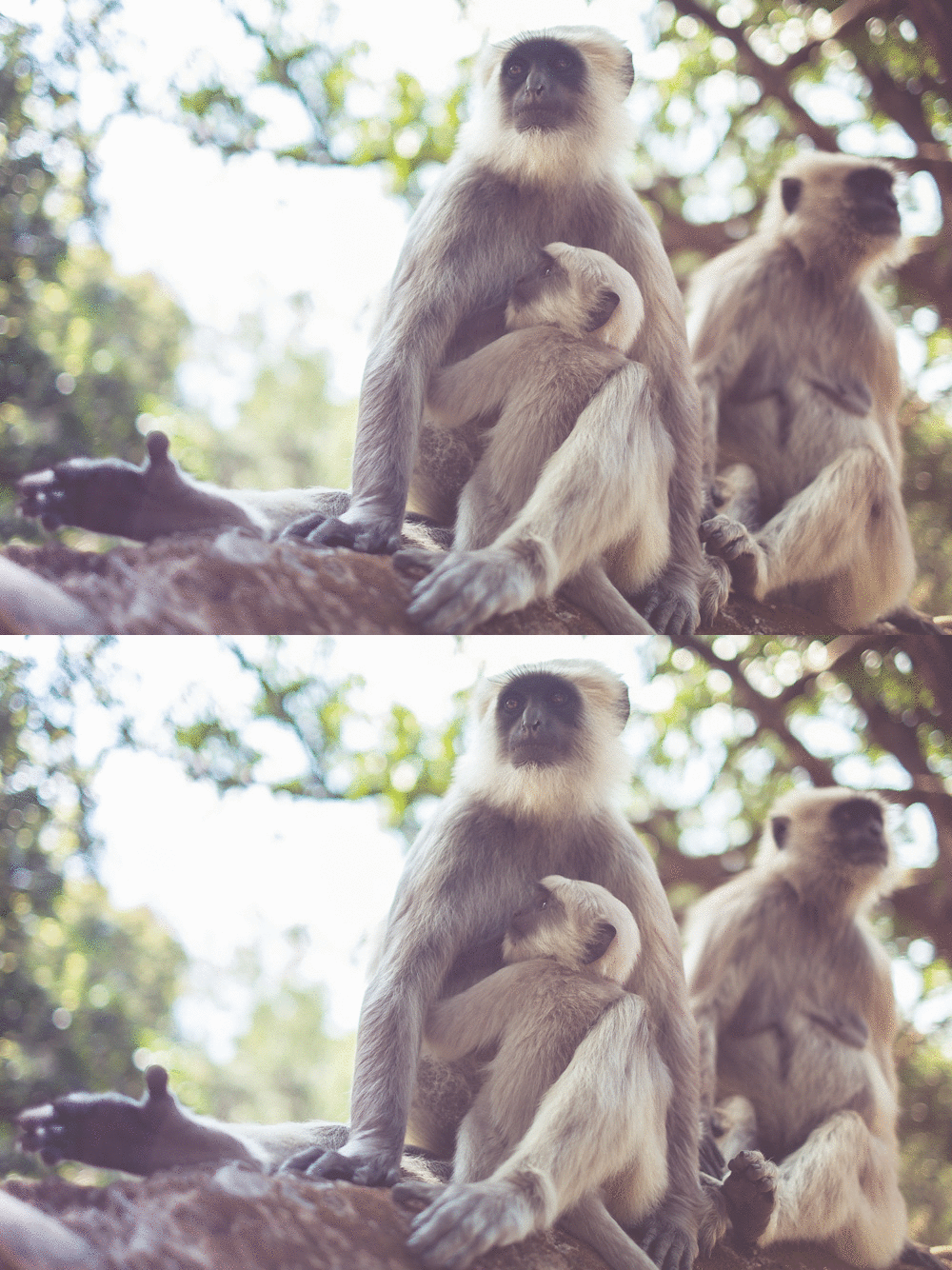
Hinduism and Buddhism compare the mind in meditation to monkeys jumping around in trees from branch to branch. These monkeys represent the constant activity of our minds. Monkey thoughts are active, and this activity is something that meditation is supposed to reduce. But meditation often is unsuccessful in doing so. Why? What can be done about it? On closer examination, we find that there are at least five trees that our monkey mind inhabits and each has its own enticing fruit. Here are descriptions of the five trees, what monkeys do in them, and what monkeys can do to live in peace.
The Tree of Thinking
We are addicted to our thoughts. We jump from thought to thought all the time, like monkeys in a tree swinging from limb to limb.
Monkeys eat the fruit on this or that limb while checking out how comfortable a particular branch is. On one limb monkeys consume the “fruit” of thinking about what they will have for dinner; the fruit of another limb is about solving a work problem; another is wondering if they are meditating properly; another is thinking about a relationship. Any thought, whether awake or asleep, is a fruit a monkey is gobbling on one or another limb of the Tree of Thinking. Monkeys spend much of their lives hanging out on their favorite limbs, swinging back and forth among them, and eating their favorite fruit. Fun!
Some approaches to meditation teach monkeys to think better thoughts. They say, “Repeat this mantra. It will bring you enlightenment.” They say, “Repeat the name of God (preferably, the name of Hanuman, the monkey god).
It will bring you sat, cit, ananda.” They say, “Repeat these affirmations. They will bring you peace of mind, health, and prosperity.” “Think the right thoughts and you will create the reality you desire!” Metaphorically, they are saying, “The fruit found on certain higher branches of the Tree of Thought are transformative. Climb up there and spend your monkey life eating those fruits and your monkey self will be enlightened.” So you scramble up to those lofty branches where the view is better and think the lofty, pure thoughts which come to you when eating the fruit of those branches.
You swing around on branches toward the top of the Thought Tree; they are obviously better than branches down lower on the thought tree because they are higher and thinner and closer to the sky. You definitely feel better because you are no longer addicted to the more mundane and imprisoning thoughts of the lower branches of your tree of thought. You can see the other monkeys better from up there. You can see more places to jump to. The fruit on the higher limbs is probably better, too. You are a pretty smart monkey to have climbed so high and to have discovered such sweet fruit.
Relatively speaking, you are smarter than those who are either oblivious to the fruit of those higher branches or too lazy or afraid to climb up after it. Smart monkeys use the higher branches of the Tree of Thinking to leverage themselves out of their attachment to this or that lower limb or to some other tree. For example, many approaches to meditation teach the use of mantras as a way to detach from lower limbs of the Tree of Thinking. Such an approach can be very helpful as long as a monkey does not confuse thinking more lofty thoughts with being completely out of the Tree of Thinking. Substituting “better” thoughts for those you were addicted to on those lower branches is a good strategy for meditation as long as you don’t think you are meditating when you are actually thinking. It is a good strategy as long as you don’t think you are free of the Tree of Thought just because you can climb all over it by controlling your thoughts or swing over into one of the other five trees, like the Tree of Images.
The Tree of Images
We monkeys are addicted to watching the pictures inside our minds. When we are not jumping around in the Tree of Thought we may be checking out the fruit of the Tree of Images. Monkeys see mental images of things they want or fear and pictures of other monkeys we know. It’s like turning on a TV inside your head or going to the movies, but without the popcorn.
When this is done in a methodical, purposeful way, it’s called “visualization.” Monkeys don’t stop jumping around in the Tree of Images just because they go to sleep. We dream an average of eight years of our lives, over hours every night, whether we remember them or not, and our dreams are full of images. Clearly, the Tree of Images is an important, ancient tree, with much to teach motivated, dedicated monkeys.
Some images are scary while others fill monkeys with sadness, anger, or desire. Some images, like those of gods, saints, bodhisattvas, and sacred symbols, are clearly the fruit of higher limbs of the Tree of Images, and monkeys can spend a lot of time climbing up there to find the best fruit. Some smart, helpful monkeys sell elaborate visualization tapes as meditation exercises. Monkeys close their eyes and visualize themselves climbing mountains or reading books of wisdom in mystic caves or imagining certain bodhisattvas. They visualize certain colors and Sanskrit letters in this or that chakra. These monkeys are told by learned monkeys that if they see the right colors in their third eye they’ll be a meditating monkey. They will attain certain forms of enlightenment when they sit on certain branches of the Tree of Images and eat those delicious fruits.
If visualization helps a monkey to meditate better, why not use it? Visualization is a wonderful tool for self-development, just as other forms of imagery, like dreamwork, can be. Visualization and imagery exercises are helpful in that they help monkeys bridge into experiencing themselves as expanded, world-encompassing monkeys. They take more inclusive monkey perspectives. They detach and accept. Problems only arise when monkeys believe that success in meditation is the same as watching Spiritual TV, Channel 00 Eating these fruits in order to see these images is a great strategy as long as monkeys don’t delude themselves into thinking that they are meditating when they are watching monkey TV. It’s fine to spend a monkey life jumping from limb to limb of the Tree of Images, feeling free, healthy, peaceful, and happy because a monkey has transcended its monkey identity with beautiful, transformational images toward the top of the Image Tree. But meditation can be something more, something that transcends any possible image available from eating any possible fruit of the Image Tree. If a monkey defines meditation as something you can watch on Spiritual TV, it may settle for less, which would be to cheat itself of its own birthright and destiny. The proper use of imagery may be for problem solving, creativity, or memory. Spiritually, its proper use is to launch monkeys out of the Tree of Imagery itself.
The Tree of Feeling
We tree-climbing monkeys are also addicted to our feelings. The limbs of happiness, romantic love, sadness, anger, fear, guilt, sorrow, confusion, brotherly love, impatience, and doubt all feel so real when a monkey is sitting, lying, or hanging from them. They feel exciting and alive! When monkeys don’t feel, life can be boring, which is another feeling. These feeling limbs feel real, as do all limbs of the Tree of Feeling. Monkeys are not only addicted to their feelings; they are addicted to their preferences, which are like fruit on the limbs of the Tree of Feeling. Monkeys like what they like and dislike what they don’t like. Monkeys want more of what they like and less of what they dislike. Getting what monkeys like and avoiding what they dislike is happiness; getting what monkeys dislike and avoiding what they like is unhappiness. Monkeys jump from feeling to feeling all the time, like a monkey in a tree hopping from limb to limb in search of a better branch with better fruit to taste.
One limb involves feeling impatient about sitting in meditation; another is feeling bored. Another limb of the Tree of Feeling is fear from a sudden loss of our sense of self. Another limb is confusion about how to meditate. A monkey may swing into the Tree of Thought or the Tree of Imagery to escape the roller coaster of its feelings. Feeling such feelings can easily take the place of any actual meditation. Many monkeys fill their minds with the search for higher and purer feelings and think they are meditating.
Some approaches to meditation teach monkeys to feel the right feelings. For instance, monkeys should meditate to experience bliss (ananda) or compassion (karuna), and both bliss and compassion are rarefied feelings. Monkeys are being told to settle down onto branches toward the top of the Feeling Tree; they are obviously better than the heavy branches down lower because they are higher and thinner and closer to the sky. This is a good strategy as long as monkeys don’t think they are meditating when they are actually feeling. Most monkeys who feel such feelings are on a high branch of the tree of feeling. They are simply deluding themselves into believing they are not feeling when they are.
There is nothing wrong with having feelings, and most monkeys agree that positive feelings are better than negative ones. Monkeys will climb very high and pass by a lot of other tempting fruit to experience feelings of bliss. The problems arise when bliss defines meditation. Most monkeys stop there.
The Tree of Sensations
Anyone that observes monkeys will notice that they are addicted to their sensations. Monkey itches, pains, and throbbings, which are the lower limbs of the Tree of Sensation, are all only too real. They tell monkeys that they are not only alive, but that things are happening. Monkeys can easily spend their time in meditation swinging from one sensation to another.
If this gets too boring, monkeys can think about their sensations, which is to swing over into the Tree of Thinking. Monkeys can also swing into the Tree of Feeling and feel something about this or that sensation, perhaps irritated that it is there or relief that it is distracting them from the work of staying clear and centered. Monkeys can decide some sensations, like pain, are bad because they make them feel unhappy and other sensations are good because they make them feel comfortable. Comfortable sensations provide comfort and support the illusion that monkeys sitting on limbs of the Tree of Sensation are accomplishing something during meditation.
Many approaches to meditation will teach a monkey that it is better to spend its time swinging around on the higher branches of the Tree of Sensation. These monkeys may think they need to concentrate on putting their consciousness in the physical space of their third eye, paying attention to breath, to vibrational pulsings, psychic energies, chakra energy emanations, or kundalini movements. Other approaches are about the special healing properties of a mala or a stone blessed by an enlightened master. If monkeys wear such sacred objects they will help the monkey to meditate because they have special energy. The diksha, or blessing, of an enlightened master will raise a monkey’s vibrations, heal its karma and make it easier for the monkey to meditate. The repetition of mantras not only involves hanging out on higher limbs of the Thinking Tree but hanging out on higher limbs of the Sensation Tree. This is because in many meditation traditions the power of the vibration or energy of the mantra lies in its particular sound, which is a sensation, not in the meaning of the words, which is often not communicated to the meditation student by the teacher. Identifying with the experience of a particular sound is a way to disidentify with other sensations and with other trees.
Repetition of mantras can be very helpful as long as a monkey does not confuse hanging out on a limb of the Tree of Sensation with being out of the tree itself. If a monkey raises its kundalini or integrates the male and female energy flows in its body, maybe it will attain enlightenment.
These approaches tell monkeys that spending their time during meditation swinging around among the higher branches of the Tree of Sensations is better than swinging around on the lower branches. This is a good strategy as long as monkeys don’t delude themselves into thinking that they are meditating when they are actually seeking to feel some rarified sensation that they get from hanging out on this or that especially high branch and enjoying its fruit. They tend to forget that they are still monkeys, locked in their monkey minds.
Clever monkeys can use the higher branches of the Tree of Sensation to leverage themselves out of their attachment to this or that lower limb or to some other tree. For instance, many approaches to meditation, including the Buddha’s, use observation of breathing as a way to detach from other trees and lower limbs of the Tree of Sensation. Breath is sensation. As such, when a monkey observes its breath it is in the Tree of Sensation. Observing breath is a way to leverage sensation to free most any monkey from all Trees. While the higher branches of any tree can be used to leverage a monkey out of his addictions to the fruits of lower limbs of all trees, breath is a special limb because it is always within swinging distance. It is primal, foundational, and intrinsic. The objective is for a monkey to observe its breath without becoming caught up in the sensations associated with it. Such an approach can be very helpful as long as a monkey does not confuse hanging out on the breathing limb of the Sensation Tree with being out of the Tree of Sensation.
The Tree of States
Monkeys move among three major limbs and several minor ones on the Tree of States. The three major limbs are waking, dreaming, and deep sleep. Some of the minor ones are daydreaming, drowsiness, intoxication, ecstasy, hypnosis, trance channeling, and coma. Monkeys who get drowsy when they meditate may spend an entire meditation period in a state of daydreaming and think that they are meditating. Some monkeys go to sleep during meditation and wake up at the end, thinking, “That was a great meditation!” What they had was a great nap.
Like a tree sloth, such monkeys are actually asleep on a lower limb of their Tree of States. When they are not eating fruit or swinging, they are used to being on the limb of dreaming (where they are also eating fruit or swinging), or on the limb of deep sleep. Consequently, beginning monkey meditators tend to either be awake and exercising control through thinking, feeling, imaging, or sensing, or are drowsy or tranced out. Learning to be none of these is one way that a monkey can frame the paradox of the relaxed alertness that is meditation.
Drowsiness, intoxication, daydreaming, dreaming, and deep sleep are the lower branches of the Tree of States while other types of consciousness, containing increasing self-awareness, are the higher branches. These are altered states of consciousness, when normal monkey mind is either significantly altered or laid aside entirely. Some approaches to meditation teach monkeys that meditation is a desirable altered state of consciousness. Perhaps it is called samadhi; perhaps it is a shamanic vision quest or a mediumistic trance. In any case, monkeys are no longer here and now if they are in another state; they have checked out on one of the higher branches of their Tree of States. Something else has checked in, and the monkey may or may not know what that something is and what it is doing and saying. Maybe it is HMM (Higher Monkey Mind). Perhaps it is the archmonkey Galadrielgibbon delivering a Special message. Perhaps it is a member of the White Monkeyhood that is speaking.
Whatever is being enlightened, whatever is experiencing enlightenment, whatever is dispensing enlightenment, it’s not the here and now monkeymind, because it’s tranced out on a limb of the Tree of States.
Trance is a state of consciousness. States of consciousness are different from stages of consciousness. Five year old and criminal monkeys can experience altered states of consciousness, including lucid dreaming, past life recall, disincarnate visits in dreams, out of the body experiences, and mediumship, but five year old and criminal monkeys are unlikely to be enlightened, regardless of what they and their impressed followers may think. Enlightenment can be a temporary state of consciousness or it can be a permanent stage of consciousness. These two are usually confused, as MonkeyMaster Ken Wilber has described, and that confusion makes successful meditation less likely. Accessing higher states of consciousness in the higher limbs of the Tree of Trance, such as developing psychic ability, lucid dreaming, mediumistic channeling, shamanic drumming, or entering samadhi, is about experiencing higher states of consciousness in the higher limbs of the Tree of States. Swinging around on such limbs will fill a monkey with a sense of power, control, and certainty that it is enlightened. Consequently, its life has new meaning, and that may involve getting other monkeys to swing around on those same limbs of the Tree of States. This will not only free them; it will validate the brilliance of that talented monkey. He will be the One, the bringer of salvation and freedom from the avidya and karma of Monkey Mind. Many of the spiritual traditions of the world have convinced monkeys that when they do manage to swing on these very remote, skinny, and beautiful tree limbs that they will be really meditating. History shows that just about any monkey can enter all sorts of fascinating trance states. Any monkey, whether gibbon, ape, baboon, or chimp, at any level of development, can experience altered states of consciousness either by accident, by cultural expectation, or with the proper training. They can learn to do meditation exercises for the purpose of entering these states, which is what traditional definitions of meditation largely entail. In effect, they say, “eat the fruit on the higher branches of the Trees of Thought, Feeling, Sensation, and Images so that you will be able to hang out on higher branches of the Tree of States. Then you’ll really be a meditating monkey.”
At some point a monkey may wake up and ask herself, “Do I want to live my life in trance? Do I see my life as a karmic entanglement from which I need to escape? Do I see the world as a mental ward while life on the planets of the Monkey star or Amida Monkey Heaven is the Place to Be?” Until he does, a monkey may spend a lot of time exploring the lofty, etherial limbs of the Tree of States.
Quintuple-Locating Monkeys
Some people claim that they can bilocate. That means that they can physically be in two places at the same time, like being at work and home in bed at the same time. This is a neat trick if you can pull it off. Monkey mind routinely surpasses this ability. It can be not in two, but in five places at the same time, and often is. For example, let’s take your typical monkey that is addicted to berries.
He just can’t pass up a juicy one. He will think, “Hmmm…That berry looks good!” At the same time he will have a feeling of desire. Then he may have a picture in his monkey head of him holding and eating the berry. Then he may experience what it tastes like, what it’s like to actually eat it. Finally, he’ll experience how much better he feels once he has what he wants: he’s in a superior state. In other words, monkeys can quintuple-locate: they can be in all five trees at the same time, and often are.
Wise monkeys have understood that such full-blown immersion in the five trees makes monkeys victims of what happens in those trees. For example, if the fruit is all sour then the monkey will be unhappy or maybe even starve. Therefore, they often recommend that monkeys quintuple-locate in the highest limbs of all five trees at the same time. For instance, a monkey might visualize a bodhisattva or the sacred heart of Jesus at the same time they are repeating a mantra or affirmation, feeling compassion for all things, experiencing their breath, and entering a state of oneness with the divine. Pretty cool, huh? Certainly it’s a whole lot better than just being a sleepwalking, or rather a sleepswinging, monkey, right?
While substituting loftier limbs with better access to the sun and gentle breezes, where there is a better view and sweeter fruit offers, some benefits that life down closer to the ground do not, sometimes you might need to be closer to the ground and sometimes you only want to be in one tree at a time. Then again, sometimes you may not want to swing any more, eat fruit any more, or be in any tree any more. In fact, you might not even want to be a monkey any more. What’s a monkey to do?
Are There Realistic Alternatives to Swinging Through Trees?
Don’t these trees comprise reality? The Buddhist world view says that they do, and many arboreal monkeys would agree. They can be equated with the five skandhas, or components of reality. These have no separate existence, “own being,” or “self” because they are interdependent. The Sensation Tree corresponds to the rupa, or “form” or “matter” aggregate. The Feeling Tree corresponds to the vedana, or “feeling” aggregate. The Image Tree corresponds to the samjna or “perception” aggregate. The Thought Tree corresponds to the samskara, or “mental formations” aggregate. The State Tree corresponds to the vijnana, or “consciousness” aggregate. Is there any reality apart from these five realms of experience? Of course there is, but no monkey will never find it as long as he equates liberation with swinging from branch to branch in one or another tree or with swinging from one tree to another. They will become Master Branch Swingers, Saintly Trancers, and Guru Fruit Eaters. Monkeys will think that meditation is freedom from this or that limb or this or that tree while remaining trapped on one or more favorite limbs of this or that favorite tree. As a result, they will never evolve higher order freedom that comes from becoming say, a flying monkey. That’s because they look no further. These talented monkeys think they are enlightened when they are actually hanging out in the higher branches of this or that tree. If one of these wise monkeys can convince enough other monkeys to buy their definition of enlightenment, monkey groupthink will validate their delusion. All those monkeys will accept the vision of that Master Monkey and stop there on that limb, because it is the Truth. As a result they will stop investigating other limbs, much less the possibility that there are alternatives to spending one’s monkey life swinging and eating fruit on this or that limb. The Master Monkey unwittingly stops those other monkeys that it is trying to enlighten from sitting on any other limb or swinging among them in any other way, or having any different fruit preferences, since every monkey knows that some fruits are conducive to enlightenment while others are rotten.
A more functional goal is to consider enlightenment as a relative process, conditioned first by the particular limb, fruit, or tree one happens to be experiencing at the moment. Enlightenment becomes a relative rather than an absolute awakening, changing according to evolving contexts and levels of monkey unfolding. Then monkeys have more of themselves balanced and operative. They take into account the inner and outer, the singular and collective aspects of their monkeying around. This is a more helpful framing of meditation, because since states change, enlightened states of consciousness do not sustain themselves. No matter how wonderful a monkey finds this or that limb in the higher branches of the Tree of States, he eventually finds himself swinging to another.
Are there really any liberating alternatives to being a limb-hopping, fruit testing monkey? Monkeys have the possibility to develop perspectives that transcend and include all trees. Higher stages of monkey evolution are relatively stable by comparison to life in the trees. It involves awareness that transcends and includes all trees, including the Tree of States. There are a number of ways to start thinking about meditation in terms of accessing the next stable stage of monkey development, in which monkeys learn to experience themselves as being much more than just monkeys. Here are several analogies that are themselves visual and experiential metaphors properly belonging to the upper branches of the thought, image, feeling, and sensory trees. In other words, they themselves are not meditation; they only point monkeys to it, like every other meditation tool.
Be a Monkey!
Monkeys do all sorts of things, but in their beingness, they simply are. When a monkey fully embraces its monkeyness it gives up doingness – thoughts, feelings, images, sensations, or trance states – for the beingness of self. This broadens and deepens a monkey’s connection with its spiritual core in a way that both sustains and gives meaning to action. Right now imagine that you aren’t about swinging, exploring trees, and eating fruit. Imagine that you are one with the beingness of your monkey self. You don’t have to change anything you do; focus on who you are. In the process, you give up identifying with any individuality separating you from other monkeys, while yet remaining the individual monkey that you are.
Be a Flying Monkey!
Most monkeys don’t fly. This is because they don’t realize that they can grow wings. Like birds, flying monkeys have wings for a reason, and it isn’t to hop from limb to limb in trees. When you become a flying monkey you can hop forever among the limbs of trees if you want, but now you also have the option to fly. You have a choice most monkeys don’t. That means that you can claim your nature as witness to all monkey thoughts, all images, all feelings, all sensations, and all monkey states. You can transcend all five trees, or you can swoop down and land in any of them and hang out on any branch you please, eating whatever fruit you want. When you become a flying monkey, watch out that you don’t lose yourself in images of the trees below or in the sensations of flying. If you do, you’re back in the Image and Sensation Trees! Take a moment now to be a flying monkey instead of just a monkey. Experience how you shift in perspective, potentials, and freedom.
Be a Tree!
When a monkey becomes the tree that it is hanging out in, it becomes one with the source of its branches and fruit. It’s all the limbs, all the fruit, plus the leaves, the trunk, and the roots! When a monkey recognizes that it is thinking instead of meditating, even if the thinking is very rarefied and subtle, she awakens to the realization that she is hanging out in the Tree of Thought. Now she has the option of becoming the Tree of Thoughts itself and thereby to become one with the source of all thoughts. That means a monkey is no longer thinking any particular monkey thought. She no longer is in the Thought Tree; she is the thought tree! Take a moment to become the source of your monkey thoughts right now. Embrace all possible limbs and fruit of the Tree of Thought. You are totally aware and knowing, but without abstract content.
When your monkey mind finds itself unintentionally in the Image Tree, become your inner TV to become one with the source of all images. That means you are no longer seeing any particular image. You are no longer in the Image Tree. You are the Image Tree. Take a moment to become one with the source of all images and experience the difference. It is as if the colors of the spectrum turned not into white light but into clear light. It is as if you became the sun instead of seeing it or viewing the solar system from the sun’s perspective.
If your monkey mind wakes up in the Feeling Tree, become it to become one with the source of all feelings. That means you are no longer feeling any particular feeling or on a roller coaster of feelings. You are no longer in the Feeling Tree. You are the Feeling Tree. You are all feelings and so transcend identification with any one feeling. You are the feeling roller coaster and so transcend identification with the feelings one has when they ride you. Take a moment to become one of your favorite strong feelings, such as impatience, anger at yourself, or worry. Now shift your focus and be the source of all possible feelings. Feel the difference. It is as if you sank beneath the waves on the surface of the ocean and became one with the deep peace of its depths.
If you are enjoying the fruit of the Sensation Tree, become it to become one with the source of all sensations. That means you are no longer experiencing any particular sensation. You are no longer in the Sensation Tree. You are the Sensation Tree. When you go to sleep you no longer feel pain because you become one with the source of all sensations. Take a moment to become one with some sensation, such as the feel of the surface you are sitting on. Now shift your focus and be the source of all possible sensations. Experience the difference. It is as if you have died but remain completely aware.
If you discover you are monkeying around in the State Tree, become it to become one with the source of all states of consciousness. That means you are no longer experiencing any particular state. You are no longer in the State Tree. You are the State Tree. Take a moment to become one with drowsiness. Now shift your focus and be the source of drowsiness. Experience the difference. It is as if you are the beingness of a tree beneath its cycles of winter hibernation and spring-summer wakefulness.
Be the Sky!
The sky embraces, transcends, and includes all trees and their contents. It doesn’t care what branches the monkeys are on or what fruit they are eating. When a monkey becomes the sky, it is no longer affected by rain or winds or by day or night. You are always an awake and aware monkey. As Sky Monkey, you do not see, because you have no eyes. You do not hear, because you have no ears. You do not sense, because you have no sense of touch. You do not feel, because you include all emotions. You do not become drowsy or experience trance states because you have no self. Although you do not experience life as the Five Trees, you most definitely include every tree, branch, and fruit. You are most definitely both alive and aware. You are always the clear witness. When you become the sky you become clear witness.
It is not that being a Sky Monkey is better than being a normal tree monkey, hopping from limb to limb. It isn’t. There are times you need to think, feel, picture, sense, and change states. These are all good things. The problems come when you are trapped in those states and have no alternatives. So it is not that one perspective that is better than another. The problem comes from not having the ability to access perspectives that transcend and include. This is why defining meditation as a higher limb of one or another of the trees is a useful but limited definition of meditation.
Be Space!
While you can imagine that you are a Space Monkey, that’s different from being a monkey that experiences itself as the cosmos, without up or down, dark or light, or time. Space has no up, no duality of this and that. It is totally full of its emptiness. Because space is unborn, it does not die. To become space is to embrace even the sky.
To become Space is to metaphorically die. It is to be dead. Space is a place without language and therefore without thought. It is a place without color and therefore without images. It is a place without stimulation and therefore without feelings or sensations. It is a place that is not a place and therefore is not a state. While Sky is metaphorically pure awareness or pure consciousness, Space witnesses both. Space witnesses the witness. If this sounds boring or uninteresting, it is because it transcends all drama and all fuel for all drama. It is the field of pure intentionality, without content, even beingness. Sky has beingness; relatively speaking, space does not.
Don’t even think about becoming a Space Monkey until you have mastered becoming Sky Monkey, or you will just become a spaced-out monkey sitting on a big fat limb on the Tree of States.
Becoming a Space Monkey is not better than being a Sky Monkey or to simply sit on some limb of some tree throwing feces at other monkeys. However, being able to be either a Space or a Sky, or a normal tree monkey is better than just being a monkey. This is because you have more choices and therefore more freedom to be whichever you choose, moment to moment. Tree Monkeys can’t choose to be Space Monkeys until they learn to experience what it is like to be a Space Monkey, but once one has learned to be a Space Monkey, you can also choose to be just a fruit-eating, ass scratching monkey when you want. The same holds true for becoming a Flying Monkey, the Monkey Trees, or a Sky Monkey. None of these perspectives are better than being a limb-swinging monkey. You can do things as a monkey that you can’t as something else, like pick bugs off other monkeys.
Be Your Breath!
There is a difference between observing your breath, as you do when you watch it move into your nostrils, down your throat, inflate your chest, and move out of your chest, throat, and nostrils, and becoming your breath. It is the difference between experiencing the limb of breathing of the Tree of Sensation (more like its trunk) and becoming the entirety of the tree itself. When you become your breath, your breath breathes you. You are no longer meditating; life is meditation.
Be High-Scoring Self-Aspects!
Whenever you become a high-scoring self-aspect you identify with a part of yourself that meditates better than you do. This is because it is more awake, alive, balanced, detached, free, and clear than you are. It probably has more confidence, compassion, wisdom, acceptance, inner peace, and witnessing than you have. If you want to easily meditate, become parts of yourself that naturally do so already, now. Remember that becoming a self-aspect is not about seeing them or seeing the world through their eyes. It is not about looking at monkeys in trees or in the sky or outer space. It is about becoming a monkey in a tree or as trees, sky, or space. It is about experiencing your beingness as monkey beingness; it is about choosing to be possessed by a part of yourself that personifies your greatest potentials because it transcends and includes all that you are. Also remember that the enlightenment of this or that aspect of yourself is always relative and will inevitably be transcended and included in more enlightened perspectives with time.
Remember that you don’t have to close your eyes to be a monkey and you don’t have to sit in the lotus posture on a branch, either. That would be pretty silly for a monkey, anyway. While the practice of meditation is a specific practice at specific times, it is meant to generalize until it becomes your everyday consciousness. Your everyday monkey mind becomes free to take whatever perspective works best at the moment. You can’t do this until you have mastered perspectives that transcend and include your own little monkey mind.
Wake up out of the Drama Triangle!
The Drama Triangle consists of taking the roles of rescuer, victim, and persecutor. Monkeys are always blaming, rescuing, or playing the victim. They beat themselves up when they don’t stop thinking. They rescue themselves with meditation techniques and teachers. They play the victim when they give up. When a monkey looks for a fruit, limb, or tree to rescue him, he takes the role of ignorant, incapable, or helpless victim. When the fruit tastes bad, the limb breaks, or the trees lose their foliage due to Agent Orange, they no longer rescue monkeys from their monkey mind or bring them enlightenment. They then become persecutors to a monkey mind. Monkey minds live in this Drama Triangle. Because they take any one of these three roles they eventually end up playing all three, which creates exciting drama but no enlightenment. Whatever role a monkey is in always feels justified, valid, and authentic when it is actually a rationalization, lie, and barrier to authenticity. There is no peace in the Drama Triangle, only excitement and a jumble of tumultuous life experiences. As some wag said, “Good judgment comes from experience, and experience comes from bad judgment.” The Five Trees are all about the Drama Triangle, for most monkeys most of the time, although it is possible to be in them without playing any of the three roles. Most monkeys spend their lives discovering who they are not, what they do not want to be or do, and who they do not want to spend time with. By the time they have figured all this out, their life is over. This is life in the Drama Triangle.
There is no intimacy in the drama triangle, just drama. If a monkey’s mind is in one of the trees, or jumping from tree to tree, whether dreaming or awake, he is in the Drama Triangle. When he or she is dreaming about ripe bananas or a favorite baboon, he is in a state of self-delusion. The monkey knows, “That limb/fruit/tree over there is better than the one I am currently on.” The contents of monkey mind can’t and won’t rescue a monkey because there is no monkey self to be rescued and no monkey identity to take these roles. Everything is on automatic pilot, a movie of highly predictable thoughts, impulses, and behaviors. To the extent that a monkey is in the Drama Triangle when he is in a tree, his life is a dream. If a monkey is in the Drama Triangle in his waking life then he is in it when he is on the highest, most wonderful limbs of any tree. In other words, monkeys think they are meditating when they are in a state of self-created drama.
To wake up out of the Drama Triangle monkeys must first learn to recognize when they are in it. They have to wake up, like the cow in the Gary Larson cartoon when she says, “Hey! Wait a minute! This is grass! We’ve been eating grass!” Awakening monkeys learn to say, “Wait! This is dream fruit! These trees are like a movie set! What am I doing eating bugs and throwing shit?” Monkeys learn to do this by first watching and listening to other monkeys. “What a drama queen! Always rescuing! Always persecuting! Always ending up playing the victim! But not me; I’m beyond that…” But then a wise monkey starts looking at her monkey thoughts and even her monkey night time dreams. She thinks, “Uh oh. Sure looks like drama to me….” Once a monkey becomes good at recognizing his immersion in the Drama Triangle he has new freedom because he has an increased ability to choose. A monkey can then choose whether to stay in some role, to switch to another role, or to stop playing altogether. Switching to another role is to simply jump to another limb or another Tree. To stop playing is to metaphorically become a monkey, a flying monkey, the tree, all trees, the sky, or deep space. Such moves bring enlightenment because they transcend and include a monkey’s previous identity as monkey mind.
Integral Deep Listening provides alternatives to the Drama Triangle. Instead of a monkey spending his life learning from experience what not to do and be, IDL encourages fellow monkeys to get in touch with those parts of themselves that already know who they are and how they need to be in the world in order to be fulfilled. Instead of identifying with the roles of rescuer, victim, and persecutor, monkeys learn to become the qualities that are the antidotes for each. Instead of mistaking life for drama, monkeys learn to be present within, above, and beyond drama. This does not mean that a monkey stops eating fruit, swinging from limb to limb, or throwing shit any more than monkeys stop being monkeys. It simply says that it is better to be able to take the perspectives not only of actors on the stage of life but also the audience, the director, and the theater, than it is to be stuck in the perspective of this or that actor all the time.


